Question
If $(\sec\theta+\tan\theta)=\text{m}$ and $(\sec\theta-\tan\theta)=\text{n},$ show that mn = 1.

Answer

We have $(\sec\theta+\tan\theta)=\text{m}\dots(\text{i})$
Again, $(\sec\theta-\tan\theta)=\text{n}\dots(\text{ii})$
Now, multiplying (i) and (ii), we get:
$(\sec\theta+\tan\theta)\times(\sec\theta-\tan\theta)=\text{mn}$
$\Rightarrow\sec^2\theta-\tan^2\theta=\text{mn}$
$\Rightarrow1=\text{mn}$ $\big[\because\sec^2\theta-\tan^2\theta=1\big]$
$\therefore\ \text{mn}=1$

Need a full question paper?

Generate a complete, print-ready paper with questions like this in minutes — across 16+ boards, with answer keys.
Start Generating Free

Similar questions

The perimeters of two similar triangles ABC and PQR are 32cm and 24cm respectively. If PQ = 12cm, find AB.
If $\theta=\frac{15}{8},$ find the value of the all T-ratios of $\theta.$
Find the sum of the integers between 100 and 200 that are-
Not divisible by 9.
[Hint: These numbers will be: Total numbers – Total numbers divisible by 9]
A right angled triangle with sides 3cm and 4cm is revolved around its hypotenuse. Find the volume of the double cone thus generated.
Solve for x.
$\frac{16}{\text{x}}-1=\frac{15}{\text{x}+1},$ $\text{x}\neq0,-1$
In a right triangle ABC in which $\angle\text{B}=90^\circ,$ a circle is drawn with AB as diameter intersecting the hypotenuse AC and P. Prove that the tangent to the circle at P bisects BC.
The sum of ages of a man and his son is 45 years. Five years ago, the product of their ages was four times the man's age at the time. Find their present ages.
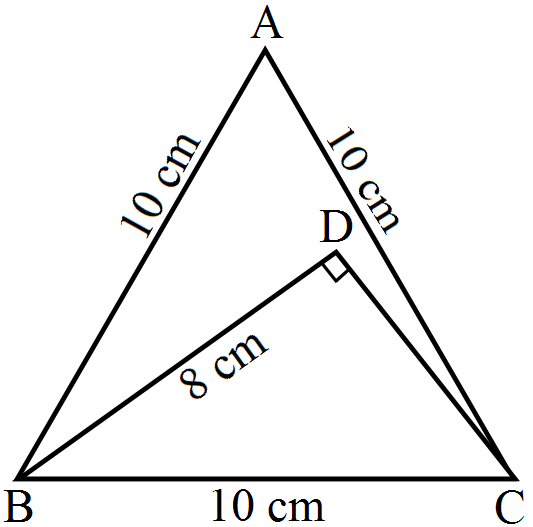
In the given figure, $\triangle\text{ABC}$ is an equilateral triangle the length of whose side is equal to 10cm, and $\triangle\text{DBC}$ is right-angled at D and BD = 8cm. Find the area of the shaded region. $\big[\text{Take}\sqrt{3}=1.41\big]$
Prove the following trigonometric identities.
If $\text{x}=\text{a}\sec\theta\cos\phi,\text{y}=\text{b}\sec\theta\sin\phi\text{ and z}=\text{c}\tan\theta,$ show that $\frac{\text{x}^2}{\text{a}^2}+\frac{\text{y}^2}{\text{b}^2}-\frac{\text{z}^2}{\text{c}^2}=1.$
$₹ 9000$ were divided equally among a certain number of persons. Had there been $20$ more persons, each would have got $₹ 160$ less. Find the original number of persons.