Question
If $\sec\theta+\tan\theta=\text{p},$ prove that:$\sin\theta=\frac{\text{p}^2-1}{\text{p}^2+1}$

Answer

We have,
$\sec\theta+\tan\theta=\text{p}\dots(1)$
$\Rightarrow\frac{\sec\theta+\tan\theta}{1}\times\frac{\sec\theta-\tan\theta}{\sec\theta-\tan\theta}=\text{p}$
$\Rightarrow\frac{\sec^2\theta-\tan^2\theta}{\sec\theta-\tan\theta}=\text{p}$
$\Rightarrow\frac{1}{\sec\theta-\tan\theta}=\text{p}$
$\Rightarrow\sec\theta-\tan\theta=\frac{1}{\text{p}}\dots(2)$
Adding (1) and (2), we get:
$2\sec\theta=\Big(\text{p}+\frac{1}{\text{p}}\Big)$
$\Rightarrow\sec\theta=\frac12\Big(\text{p}+\frac{1}{\text{p}}\Big)\dots(\text{A})$
Subtracting (2) from (1), we get:
$2\tan\theta=\Big(\text{p}-\frac{1}{\text{p}}\Big)$
$\Rightarrow\tan\theta=\frac12\Big(\text{p}-\frac{1}{\text{p}}\Big)\dots(\text{B})$
Using (A) and (B), we get:
$\sin\theta=\frac{\tan\theta}{\sec\theta}$
$=\frac{\frac12\Big(\text{p}-\frac{1}{\text{p}}\Big)}{\frac12\Big(\text{p}+\frac{1}{\text{p}}\Big)}$
$=\frac{\Big(\frac{\text{p}^2-1}{\text{p}}\Big)}{\Big(\frac{\text{p}^2+1}{\text{p}}\Big)}$
$\therefore\ \sin\theta=\frac{\text{p}^2-1}{\text{p}^2+1}$

Need a full question paper?

Generate a complete, print-ready paper with questions like this in minutes — across 16+ boards, with answer keys.
Start Generating Free

Similar questions

Solve the following systems of equations by using the method of cross multiplication:
$\frac{\text{ax}}{\text{b}}-\frac{\text{by}}{\text{a}}=\text{a}+\text{b},$
$\text{ax}-\text{by}=\text{2ab}$
A part of monthly hostel charges in a college hostel are fixed and the remaining depends on the number of days one has taken food in the mess. When a student A takes food for 25 days, he has to pay ₹ 4500, whereas a student B who takes food for 30 days, he has to pay ₹ 5200. Find the fixed charges per month and the cost of the food per day.
If twice the son's age in years is added to the father's age, the sum is 70 years. But, if twice the father's age is added to the son's age, the sum is 95 years. Find the age of the father and son.
Find the area of a rhombus each side of the which measures 20cm and one of whose diagonals is 24cm.
Find the roots of the following equations, if they exist, by applying the quadratic formula:
$x^2 - 2ax - (4b^2 - a^2) = 0$
In a right $\triangle\text{ABC},$ right-angled at B, if $\tan\text{A}=1$ then verify that $2\sin\text{A}\cdot\cos\text{A}=1.$
A sailor goes 8km downstream in 40 minutes and returns in 1 hour. Find the speed of the sailor in still water and the speed of the current.
Solve the following quadratic equation:
$\frac{\text{x}-4}{\text{x}-5}+\frac{\text{x}-6}{\text{x}-7}=3\frac{1}{3},$ $\text{x}\neq5,7$
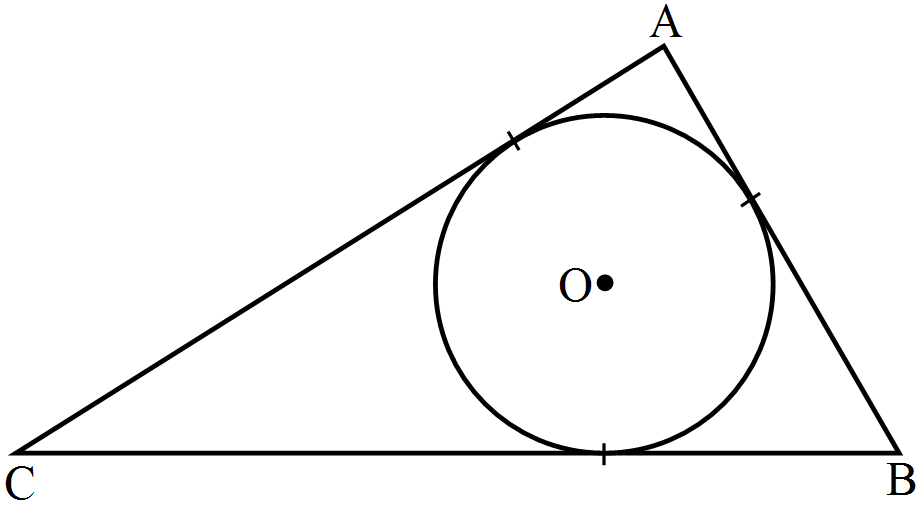
In the given figure, $\triangle\text{ABC}$ is right-angled at A. Find the area of the shaded region if AB = 6cm, BC = 10cm and O is the centre of the incircle of $\triangle\text{ABC}.\ \big[\text{Take }\pi=3.14\big]$
The sum of two numbers is 137 and their difference is 43. Find the numbers.