Question
If $\sin\text{A}=\frac{9}{41},$ find the value of $\cos\text{A}$ and $\tan\text{A}.$
Answer


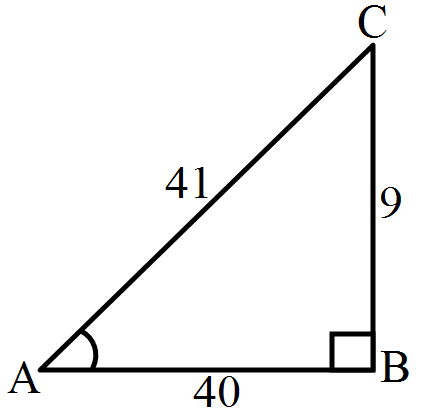
Cosider $\triangle\text{ABC},$ where $\angle\text{B}=90^\circ$
Then, $\sin\text{A}=\frac{\text{Perpendicular}}{\text{Hypotenuse}}=\frac{\text{BC}}{\text{AC}}=\frac{9}{41}$
Let $BC = 9$ and $AC = 41$
Then, by Pythagoras theoram,
$ A C^2=(A B)^2+(B C)^2$
$ \Rightarrow(A B)^2=(A C)^2-(B C)^2 $
$ =41^2-9^2=1681-81=1600$
$\Rightarrow A B=40$
Now,
$\cos\text{A}=\frac{\text{Base}}{\text{Hypotenuse}}=\frac{\text{AB}}{\text{AC}}=\frac{40}{41}$
$\tan\text{A}=\frac{\text{Perpendicular}}{\text{Base}}=\frac{\text{BC}}{\text{AB}}=\frac{9}{40}$

Need a full question paper?

Generate a complete, print-ready paper with questions like this in minutes — across 16+ boards, with answer keys.
Start Generating Free

Similar questions

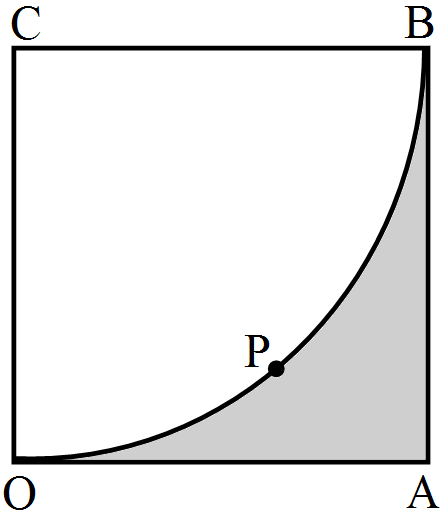
In the given figure, $OABC$ is a square of side $7\ cm$. If $COPB$ is a quadrant of a circle with centre $C$ find the area of the shaded region.
Find the roots of the following quadratic equation (if they exist) by the method of completing the square.
$4\text{x}^2+4\sqrt{3}\text{x}+3=0$
The sum of the numerator and denominator of a fraction is $8$. If $3$ is added to both of the numerator and the denominator, the fraction becomes $\frac{3}{4}.$ Find the fraction.
A takes $3$ hours more than $B$ to walk a distance of $30\ km$. But, if $A$ doubles his pace (speed) he is ahead of $B$ by $1\frac{1}{2}$ hours. Find the speeds of $A$ and $B.$
Find the mode, median and mean for the following data:
Marks obtained
$25-35$
$35-45$
$45-55$
$55-65$
$65-75$
$75-85$
Number of students
$7$
$31$
$33$
$17$
$11$
$1$
Red queens and black jacks are removed from a pack of $52$ playing cards. A card is drawn at random from the remaining cards, after reshuffling them. Find the probability that the card drawn is:
  1. A king.
  2. Of red colour.
  3. A face card.
  4. A queen.
A card is drawn at random from a well-shuffled deck of $52$ cards. Find the probability of getting:
  1. A queen.
  2. A diamond.
  3. A king or an ace.
  4. A red ace.
Find the next five terms of the following sequences given:
$a_1=a_2=2, a_n=a_{n-1}-3, n>2$
All the black face cards are removed from a pack of $52$ cards. The remaining cards are well shuffled and then a card is drawn at random. Find the probability to getting a:
  1. Face card.
  2. Red card.
  3. Black card.
  4. King.
If the zeros of the polynomial $f(x) = ax^3+ 3bx^2+ 3cx + d$ are in A.P., prove that $2b^3- 3abc + a^2d = 0.$