Question
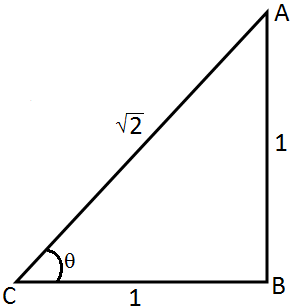
If $\sin\theta=\frac{1}{\sqrt{2}},$ find all other trigonometric rations of angle $\theta$.
Answer

We have $\sin\theta=\frac{1}{\sqrt{2}}$

In $\triangle\text{ABC}$
$\text{AC}^2=\text{AB}^2+\text{BC}^2$
$\Rightarrow\ (\sqrt{2})=(1)^2+\text{BC}^2$
$\Rightarrow\ \text{BC}^2=2-1$
$\Rightarrow\ \text{BC}=1$
$\therefore\ \cos\theta=\frac{\text{BC}}{\text{AC}}=\frac{1}{\sqrt{2}}$
$\tan\theta=\frac{\text{AB}}{\text{BC}}=\frac{1}{1}=1$
$\cot\theta=\frac{1}{\tan\theta}=1$
$\sec\theta=\frac{1}{\cos\theta}=\sqrt{2}$
$\text{cosec }\theta=\frac{1}{\sin\theta}=\sqrt{2}$

Need a full question paper?

Generate a complete, print-ready paper with questions like this in minutes — across 16+ boards, with answer keys.

Start Generating Free

Similar questions

Five cards the ten, jack, queen, king and ace of diamonds, are well-shuffled with their face downwards. One card is then picked up at random.
  1. What is the probability that the card is the queen?
  2. If the queen is drawn and put a side, what is the probability that the second card picked up is:
  1. An ace$?$
  2. A queen$?$
In the following, find the value of k for which the given value is a solution of the given equation:
$ x^2-x(a+b)+k=0, x=a $
Represent the situation in the form of the quadratic equation:
The product of two consecutive positive integers is 306. Form the quadratic equation to find the integers.
In figure $A, B$ and $C$ are points on $OP, OQ$ and $OR$ respectively such that $AB || PQ$ and $AC || PR$. Show that $BC || QR$.
Find the $LCM$ and $HCF$ of the following integer by applying the prime factorisation method.
$12, 15$ and $21$
Very-Short and Short-Answer Qustions:
If $\cos\text{B}=\frac35$ and $(\text{A}+\text{B})=90^\circ,$ what is the value of $\sin\text{A}.$
A lending library has a fixed charge for the first three days and an additional charge for each day thereafter. Saritha paid $₹ 27$ for a book kept for seven days, while Susy paid $₹ 21$ for the book she kept for five days. Find the fixed charge and the charge for each extra day. Solve the pair of the linear equation obtained by the elimination method.
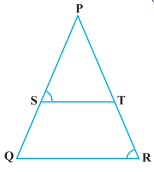
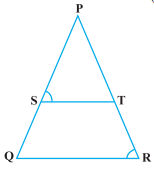
In Fig. $\frac { P S } { S Q } = \frac { P T } { T R }$ and $\angle P S T = \angle P R Q.$ Prove that $ \triangle$$PQR$ is an isosceles triangle.