Question
If $\sin\theta=\frac{\text{a}}{\text{b}},$ show that $(\sec\theta+\tan\theta)=\sqrt{\frac{\text{b}+\text{a}}{\text{b}-\text{a}}}.$
Answer


$\sin\theta=\frac{\text{a}}{\text{b}}$
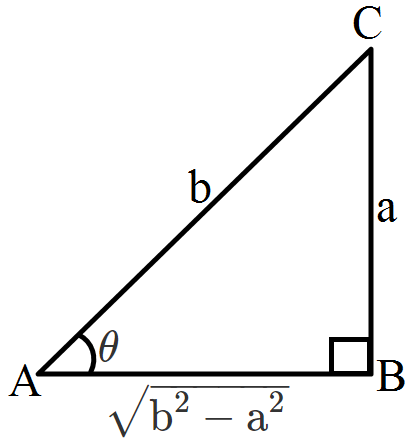
Consider $\triangle\text{ABC},$ where $\angle\text{B}=90^\circ$ and $\angle\text{A}=\theta$
Then, $\sin\theta=\frac{\text{Perpendicular}}{\text{Hypotenuse}}=\frac{\text{BC}}{\text{AC}}=\frac{\text{a}}{\text{b}}$
Let BC = a and AC = b
Then, by pythagoras theorem,
$\text{AB}^2 = \text{AC}^2 - \text{BC}^2 = \text{b}^2 - \text{a}^2$
$\Rightarrow\text{AB}=\sqrt{\text{b}^2-\text{a}^2}$
Now,
$\sec\theta=\frac{\text{Hypotenuse}}{\text{Base}}=\frac{\text{AC}}{\text{AB}}=\frac{\text{b}}{\sqrt{\text{b}^2-\text{a}^2}}$
$\tan\theta=\frac{\text{Perpendicular}}{\text{Base}}=\frac{\text{BC}}{\text{AB}}=\frac{\text{a}}{\sqrt{\text{b}^2-\text{a}^2}}$
$\therefore\text{L.H.S.}=(\sec\theta+\tan\theta)$
$=\frac{\text{b}}{\sqrt{\text{b}^2-\text{a}^2}}+\frac{\text{a}}{\sqrt{\text{b}^2-\text{a}^2}}$
$=\frac{\text{b}+\text{a}}{\sqrt{\text{b}^2-\text{a}^2}}$
$\frac{\text{b}+\text{a}}{\sqrt{(\text{b}+\text{a})(\text{b}-\text{a})}}$
$=\frac{{\sqrt{\text{b}+\text{a}}}\times\sqrt{\text{b}+\text{a}}}{\sqrt{(\text{b}+\text{a})}\times\sqrt{\text{b}-\text{a}}}$
$=\sqrt{\frac{\text{b}+\text{a}}{\text{b}-\text{a}}}$
$=\text{R.H.S.}$

Need a full question paper?

Generate a complete, print-ready paper with questions like this in minutes — across 16+ boards, with answer keys.

Start Generating Free

Similar questions

A bucket made of a aluminium sheet is of height 20cm and its upper and lower ends are of radius 25cm and 10cm respectively. Find the cost of making the bucket if the aluminium sheet costs Rs 70 per $100cm^2$. $(\text{use}\ \pi=3.14)$
A footpath of uniform width runs all around the inside of a rectangular field 54m long and 35m wide. If the area of the path is $420m^2$​​​​​​​., find the width of the path.
The first and the last terms of an AP are 17 and 350 respectively. If the common difference is 9, how many terms are there and what is their sum?
Find the values of k for which the given quadratic equation has real and distinct roots:
$5x^2 - kx + 1 = 0$
Determine a point which divides a line segment of length 12cm internally in the ratio 2 : 3. Also justify your construction.
In a $\triangle\text{ABC},\angle\text{B}=90^\circ$ and $\tan\text{A}=\frac{1}{\sqrt{3}}.$ Prove that:
  1. $\sin\text{A}\cdot\cos\text{C}+\cos\text{A}\cdot\sin\text{C}=1$
  2. $\cos\text{A}\cdot\cos\text{C}-\sin\text{A}\cdot\sin\text{C}=0$
Draw the graphs of the following equations:
$\begin{array}{l}x+y=5 \\x-y=5\end{array}$
(i) Find the solution of the equations from the graph.
(ii) Shade the triangular region formed by the lines and the $y$-axis.
Solve the following system of equations graphically:
2x + 3y = 2,
x - 2y = 8
Ved travels $600 \ km$ to his home partly by train and partly by car. He takes $8$ hours if he travels $120 \ km$ by train and the rest by car. He takes $20$ minutes longer if he travels $200 \ km$ by train and the rest by car. Find the speed of the train and the car.
Find the quadratic polynomial, sum of whose zeros is 8 and their product is 12. Hence, find the zeros of the polynomial.