Question
If $\sin\theta=\frac{\text{a}}{\text{b}},$ show that $(\sec\theta+\tan\theta)=\sqrt{\frac{\text{b}+\text{a}}{\text{b}-\text{a}}}.$
Answer


$\sin\theta=\frac{\text{a}}{\text{b}}$
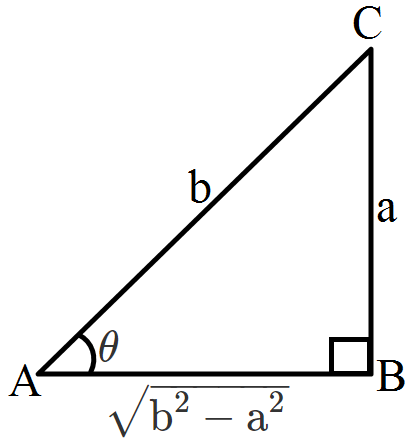
Consider $\triangle\text{ABC},$ where $\angle\text{B}=90^\circ$ and $\angle\text{A}=\theta$
Then, $\sin\theta=\frac{\text{Perpendicular}}{\text{Hypotenuse}}=\frac{\text{BC}}{\text{AC}}=\frac{\text{a}}{\text{b}}$
Let BC = a and AC = b
Then, by pythagoras theorem,
$\text{AB}^2 = \text{AC}^2 - \text{BC}^2 = \text{b}^2 - \text{a}^2$
$\Rightarrow\text{AB}=\sqrt{\text{b}^2-\text{a}^2}$
Now,
$\sec\theta=\frac{\text{Hypotenuse}}{\text{Base}}=\frac{\text{AC}}{\text{AB}}=\frac{\text{b}}{\sqrt{\text{b}^2-\text{a}^2}}$
$\tan\theta=\frac{\text{Perpendicular}}{\text{Base}}=\frac{\text{BC}}{\text{AB}}=\frac{\text{a}}{\sqrt{\text{b}^2-\text{a}^2}}$
$\therefore\text{L.H.S.}=(\sec\theta+\tan\theta)$
$=\frac{\text{b}}{\sqrt{\text{b}^2-\text{a}^2}}+\frac{\text{a}}{\sqrt{\text{b}^2-\text{a}^2}}$
$=\frac{\text{b}+\text{a}}{\sqrt{\text{b}^2-\text{a}^2}}$
$\frac{\text{b}+\text{a}}{\sqrt{(\text{b}+\text{a})(\text{b}-\text{a})}}$
$=\frac{{\sqrt{\text{b}+\text{a}}}\times\sqrt{\text{b}+\text{a}}}{\sqrt{(\text{b}+\text{a})}\times\sqrt{\text{b}-\text{a}}}$
$=\sqrt{\frac{\text{b}+\text{a}}{\text{b}-\text{a}}}$
$=\text{R.H.S.}$

Need a full question paper?

Generate a complete, print-ready paper with questions like this in minutes — across 16+ boards, with answer keys.

Start Generating Free

Similar questions

The sum of ages of a man and his son is $45$ years. Five years ago, the product of their ages was four times the man's age at the time.
Find their present ages.
The following table gives the distribution of the life time of 400 neon lamps:
Life time (in hours)
Number of lamps
1500-2000
2000-2500
2500-3000
3000-3500
3500-4000
4000-4500
4500-5000
14
56
60
86
74
62
48
Find the median life.
Using the determinants given below form two linear equations and solve them.
$D=\left|\begin{array}{cc}5 & 7 \\ 2 & -3\end{array}\right| \quad D y=\left|\begin{array}{cc}5 & 4 \\ 2 & -10\end{array}\right|$
A regular hexagon is inscribed in a circle. If the area of hexagon is $24\sqrt{3}\text{cm}^2,$ find the area of the circle. $\big(\text{Use }\pi=3.14\big)$
Two poles of equal heights are standing opposite to each other on either side of the road which is 80m wide. From a point P between them on the road, the angle of elevation of the top of one pole is 60° and the angle of depression from the top of another pole at P is 30°. Find the height of each pole and distances of the point P from the poles.
Solve the following quadratic equations by factorization:
$\frac{1}{\text{x}-2}+\frac{2}{\text{x}-1}=\frac{6}{\text{x}},$ $\text{x}\neq0$
In the given figure, $ABC$ is a right triangle right-angled at $B$ such that $BC = 6cm$ and $AB = 8cm$. Find the radius of its in circle.
A boat goes 24km upstream and 28km downstream in 6 hrs. It goes 30km upstream and 21km downstream in $6\frac{1}{2}$ hrs. Find the speed of the boat in still water and also speed of the stream.
In an isosceles $\triangle\text{ABC,}$ the base $AB$ is produced both the ways to $P$ and $Q$ such that $AP \times BQ = AC^2.$ Prove that $\triangle\text{APC}\sim \triangle\text{BCQ}.$
$4 x-y=-5 ; 2 x-y=-1$