MCQ
If solid sphere and solid cylinder of same radius and density rotate about their own axis, the moment of inertia will be greater for $(L = R)$
  • Solid cylinder
  • B
     Solid sphere 
  • C
    Both
  • D
    Equal both

Answer

Correct option: A.
Solid cylinder
a
Moment of inertia of solid cylinder about $z$ -axis passing through its centre and parallel to its height is given by: $I_{C}=\frac{1}{2} M R^{2}=0.5 M R^{2}$

Moment of inertia of solid cylinder about an axis passing through its centre s given by:

$I_{S}=\frac{2}{5} M R^{2}=0.4 M R^{2}$

So, $I_{C}>I_{S}$

Hence, The moment of inertia of the solid cylinder will be greater than that of solid sphere.

Need a full question paper?

Generate a complete, print-ready paper with questions like this in minutes — across 16+ boards, with answer keys.
Start Generating Free

Similar questions

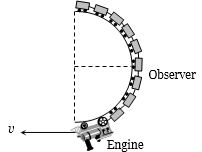
A train has just complicated a $U-$curve in a track which is a semicircle. The engine is at the forward end of the semi circular part of the track while the last carriage is at the rear end of the semicircular track. The driver blows a whistle of frequency $200 Hz.$ Velocity of sound is $340 m/sec$. Then the apparent frequency as observed by a passenger in the middle of a train when the speed of the train is $30 m/sec$ is  ... $Hz$
Two identical particles each of mass $m$ go round a circle of radius $a$ under the action of their mutual gravitational attraction. The angular speed of each particle will be
A small ball of mass $m$ is thrown upward with velocity $u$ from the ground. The ball experiences a resistive force $mkv ^{2}$ where $v$ is its speed. The maximum height attained by the ball is 
Unit of energy in $SI$ system is
A liquid of mass $M$ and specific heat $S$ is at a temperature $2t$. If another liquid of thermal capacity $1.5$ times, at a temperature of $\frac{t}{3}$ is added to it, the resultant temperature will be
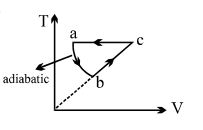
$PV$ curve for the process whose $VT$ curve is
Three forces $\vec{F}_1=(2 \hat{i}+4 \hat{j}) \,N ; \vec{F}_2=(2 \hat{j}-\hat{k}) \,N$ and $\vec{F}_3=(\hat{k}-4 \hat{i}-2 \hat{j}) \,N$ are applied on an object of mass $1 kg$ at rest at origin. The position of the object at $t=2 s$ will be
Two masses $8\; kg$ and $12\; kg$ are connected at the two ends of a light inextensible string that goes over a frictionless pulley. Find the acceleration of the masses, and the tension in the string when the masses are released.
The distance moved by a particle in simple harmonic motion in one time period is:
  1. A
  2. 2A
  3. 4A
  4. zero.
A sound source is moving towards a stationary listener with $\frac{1}{10}$ of the speed of sound. The ratio of apparent to real frequency is: