MCQ
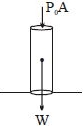
If solid will break under pressure greater than $13\  atm$ and that solid has a specific gravity of $4$ , what is the maximum height of a cylinder made from the solid that can be built at the earth's surface ? (Note: $1\ atm$ = $10^5\  Pa$ .) ......... $m$
  • A
    $4$
  • B
    $32.5$
  • C
    $24$
  • $30$

Answer

Correct option: D.
$30$
d
$\mathrm{P}_{0} \mathrm{A}+\mathrm{hA} \rho \mathrm{g}=\mathrm{P}_{1} \mathrm{A}$

$\mathrm{h}=\frac{\mathrm{P}_{1}-\mathrm{P}_{0}}{\rho \mathrm{g}}$

$=\frac{12 \times 10^{5}}{4 \times 10^{3} \times 10}=30 \mathrm{m}$

Need a full question paper?

Generate a complete, print-ready paper with questions like this in minutes — across 16+ boards, with answer keys.

Start Generating Free

Similar questions

The $SI$ unit of universal gas constant is
If an object is projected vertically upwards with speed, half the escape speed of earth, then the maximum height attained by it is [ $R$ is radius of earth]
In which form, the energy is stored in a fuel?
Certain neutron stars are believed to be rotating at about $1\,rev/\sec $. If such a star has a radius of $ 20\, km$, the acceleration of an object on the equator of the star will be
If $\mathrm{E}$ and $\mathrm{G}$ respectively denote energy and gravitational constant, then $\frac{\mathrm{E}}{\mathrm{G}}$ has the dimensions of :
Three bodies have equal masses $m$. Body $A$ is solid cylinder of radius $R$, body $B$ is a square lamina of side $R$, and body $C$ is a solid sphere of radius $R$. Which body has the smallest moment of inertia about an axis passing through their centre of mass and perpendicular to the plane (in case of lamina)
Two identical coherent sound sources $R$ and $S$ with frequency $f$ are $5 \,m$ apart. An observer standing equidistant from the source and at a perpendicular distance of $12 \,m$ from the line $R S$ hears maximum sound intensity.When he moves parallel to $R S$, the sound intensity varies and is a minimum when he comes directly in front of one of the two sources. Then, a possible value of $f$ is close to ............ $Hz$ (the speed of sound is $330 \,m / s$ )
In order to shift a body of mass $m$ from a circular orbit of radius $3R$ to a higher radius $5R$ around the earth, the work done is
The acceleration vector of a particle in uniform circular motion averaged over the cycle is a null vector. This statement is
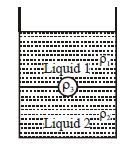
Diagram shows a jar filled with two non mixing liquids $1$ and $2$ having densities ${\rho _1}$ and  ${\rho _2}$  respectively. A solid ball, made of a material of density  ${\rho _3}$ , is dropped in the jar. It comes to equilibrium in the position shown in the figure. Which of the following is true for ${\rho _1}$ ,  ${\rho _2}$ and ${\rho _3}$  ?