MCQ
If $\sqrt{\text{a}+\text{ib}}=\text{x}+\text{iy},$ then possible value of $\sqrt{\text{a}-\text{ib}}$ is:
  • A
    $\text{x}^2+\text{y}^2$
  • B
    $\sqrt{\text{x}^2+\text{y}^2}$
  • C
    $\text{x}+\text{iy}$
  • $\text{x}-\text{iy}$

Answer

Correct option: D.
$\text{x}-\text{iy}$
$\sqrt{\text{a}+\text{ib}}=\text{x}+\text{iy}$
Squaring on both the sides, we get,
$\text{a}+\text{ib}=\text{x}^2+(\text{iy})^2+2\text{ixy}$
$\Rightarrow\text{a}+\text{ib}=(\text{x}^2-\text{y}^2)+2\text{ixy}$
$\therefore\text{a}=(\text{x}^2-\text{y}^2)$
and $\text{b}=2\text{xy}$
$\therefore\text{a}-\text{ib}=(\text{x}^2-\text{y}^2)-2\text{ixy}$
$\Rightarrow\text{a}-\text{ib}=\text{x}^2+\text{i}^2\text{y}^2-2\text{ixy} \ [\because\text{i}^2=-1]$
Taking square root on both the sides, we get:
$\sqrt{\text{a}-\text{ib}}=\text{x}-\text{iy}$

Need a full question paper?

Generate a complete, print-ready paper with questions like this in minutes — across 16+ boards, with answer keys.
Start Generating Free

Similar questions

If $L=\overset{lim}{x^2\rightarrow a} \frac{b-cos(x^2-a)}{(x^2-a)sin(cx^2-a)}$ is non-zero finite $(a > 0),$ then-
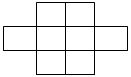
Six $‘X'$ s have to be placed in the square of the figure such that each row contains at least one $X$. In how many different ways can this be done
Vertex of the parabola $9{x^2} - 6x + 36y + 9 = 0$ is
Choose the correct answer. The real value of $\theta$ for which the expression $\frac{1+\text{i}\cos\theta}{1-2\text{i}\cos\theta}$ is a real number is:
Let $C_i \equiv  x^2 + y^2 = i^2 (i = 1,2,3)$ are three circles. If there are $4i$ points on circumference of circle $C_i$. If no three of all the points on three circles are collinear then number of triangles which can be formed using these points whose circumcentre does not lie on origin, is-
The equation whose roots are reciprocal of the roots of the equation $3{x^2} - 20x + 17 = 0$ is
Urn $A$ contains $6$ red and $4$ black balls and urn $B$ contains $4$ red and $6$ black balls. One ball is drawn at random from urn $A$ and placed in urn $B$. Then one ball is drawn at random from urn $B$ and placed in urn $A$. If one ball is now drawn at random from urn $A$, the probability that it is found to be red, is
If the point $\left(\alpha, \frac{7 \sqrt{3}}{3}\right)$ lies on the curve traced by the mid-points of the line segments of the lines $x$ $\cos \theta+ y \sin \theta=7, \theta \in\left(0, \frac{\pi}{2}\right)$ between the coordinates axes, then $\alpha$ is equal to
The term independent of $x$ in expansion of ${\left( {\frac{{x + 1}}{{{x^{2/3}} - {x^{\frac{1}{3}}} + 1\;}}--\frac{{x - 1}}{{x - {x^{1/2}}}}} \right)^{10}}$ is
If $\text{z}=1-\cos\theta+\text{i}\sin\theta,$ then $|\text{z}|=$