MCQ
If $\tan ^{-1}(\cot \theta)=2 \theta$, then $\theta$ is equal to
  • A
    $\frac{\pi}{3}$
  • B
    $\frac{\pi}{4}$
  • C
    $\frac{\pi}{6}$
  • D
    None of these

Answer

$
\begin{array}{l}
\text { (c) }: \tan ^{-1}(\cot \theta)=2 \theta \Rightarrow \cot \theta=\tan 2 \theta \\
\Rightarrow \cot \theta=\cot \left(\frac{\pi}{2}-2 \theta\right) \Rightarrow \theta=\frac{\pi}{2}-2 \theta \\
\Rightarrow \quad 3 \theta=\frac{\pi}{2} \Rightarrow \theta=\frac{\pi}{6}
\end{array}
$

Need a full question paper?

Generate a complete, print-ready paper with questions like this in minutes — across 16+ boards, with answer keys.

Start Generating Free

Similar questions

The value of c in Lagrange's mean value theorem for the function f(x) = x(x - 2) when $\text{x}\in[1,2]$ is:
  1. $1$
  2. $\frac{1}{2}$
  3. $\frac{2}{3}$
  4. $\frac{3}{2}$
Choose the correct answer from the given four options.

If $\text{P}(\text{A}\cap\text{B})=\frac{7}{10},$ and $\text{P}(\text{B})=\frac{17}{20},$ then $\text{P}\Big(\frac{\text{A}}{\text{B}}\Big)$ equas:
Let $f(x) = (1 + {b^2}){x^2} + 2bx + 1$ and $m(b)$ the minimum value of $f(x)$ for a given $b$. As $b$ varies, the range of $m(b)$ is
The solution of the differential equation $\frac{{dy}}{{dx}} + y\cot x = 2\cos x$ is
The value of $ \cos { \left( \tan ^{ -1 }{ \tan { 4 } } \right) }$ is-
  1. $ \frac { 1 }{ \sqrt { 17 } }$
  2. $ \frac { 1 }{ \sqrt {- 17 } }$
  3. $ \frac { 1 }{ \sqrt {- 14 } }$
  4. $ -\cos 4$
Let $f : R \rightarrow R$ and $g : R \rightarrow R$ be two functions defined by $f(x)=\log _{e}\left(x^{2}+1\right)-e^{-x}+1$ and $g(x)=\frac{1-2 e^{2 x}}{e^{x}}$. Then, for which of the following range of $\alpha$, the inequality $f\left(g\left(\frac{(\alpha-1)^{2}}{3}\right)\right)>f\left(g\left(\alpha-\frac{5}{3}\right)\right)$ holds?
Volume of purullclopipcd determined by vectors $\vec a + \vec b,\vec b + \vec c$ and $\vec c + \vec a$ is $4$. Then the volume of the parallelopiped determined by vectors $\vec a \times \vec b,\vec b \times \vec c$ and $\vec c \times \vec a$ is
Solution of the differential equation $\cos x\;dy = y\left( {\sin x - y} \right)dx,0 < x < \frac{\pi }{2}$ is
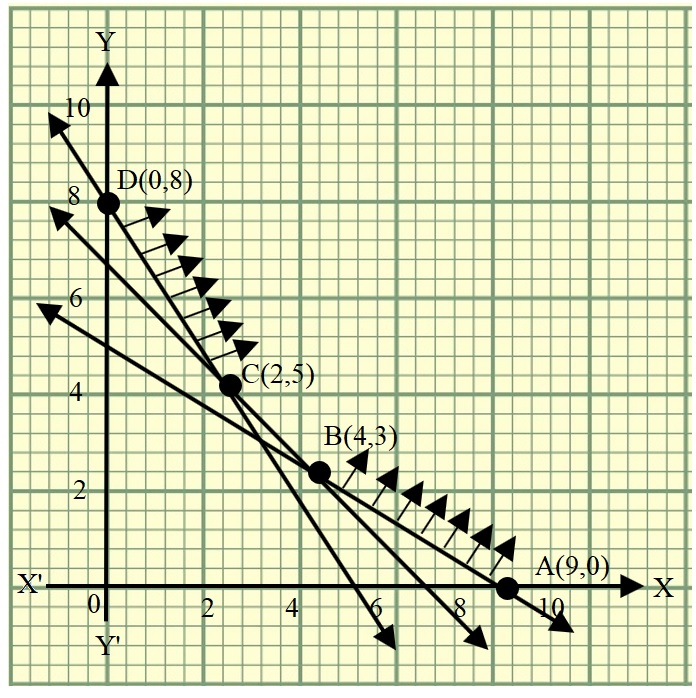
Feasible region (shaded) for a LPP is shown in the given figure. Minimum of z = 4x + 3y occurs at the point.

If $\text{y}^\frac{1}{\text{n}}+\text{y}-^\frac{1}{\text{n}}=2\text{x}$ then find $(\text{x}^2-1)\text{y}_2+\text{xy}_1=$ 
  1. -n2y
  2. n2y
  3. 0
  4. None of these.