Question
If tan θ = 2, find the values of other trigonometric ratios.

Answer

We know that,
$\sec ^2 \theta=1+\tan ^2 \theta$
$\Rightarrow \sec ^2 \theta=1+(2)^2$
$\Rightarrow \sec ^2 \theta=5$
$\Rightarrow \sec \theta=\sqrt{ } 5 \ldots[1]$
Also,
$\cos \theta=\frac{1}{\sec \theta}$
$\Rightarrow \cos \theta=\frac{1}{\sqrt{5}}$
Now, using
$\tan \theta=\frac{\sin \theta}{\cos \theta}$
$\Rightarrow 2=\frac{\sin \theta}{\frac{1}{\sqrt{5}}}$
$\Rightarrow \sin \theta=2 \times \frac{1}{\sqrt{5}}$
$\Rightarrow \sin \theta=\frac{2}{\sqrt{5}} \ldots[3]$
Also,
$\operatorname{cosec} \theta=\frac{1}{\sin \theta}=\frac{\sqrt{5}}{2}$
$\cot \theta=\frac{1}{\tan \theta}=\frac{1}{2}$

Need a full question paper?

Generate a complete, print-ready paper with questions like this in minutes — across 16+ boards, with answer keys.
Start Generating Free

Similar questions

There are 37 terms in an A.P., the sum of three terms placed exactly at the middle is 225 and the sum of last three terms is 429. Write the A.P.

Image
Solve : $3 x+4 y=-5 ; x-y=-4$
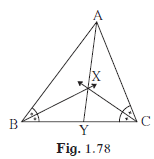
In fig 1.78, bisectors of ∠B and ∠C of ΔABC intersect each other in point X. Line AX intersects side BC in point Y. AB = 5, AC = 4, BC = 6 then find $\frac{AX}{XY}.$
Find the lengths of the medians AD and BE of $\triangle\text{ABC}$ whose vertices are A(7, -3), B(5, 3) and C(3, 1).
Determine the number nearest to $110000$ but greater than $100000$ which is exactly divisible by each of $8, 15$ and $21.$
The agewise participation of students in the Annual Function of a school is shown in the following distribution.
Age (in years) 5-7 7-9 9-11 11-13 13−15 15−17 17−19
Number of students x 15 18 30 50 48 x
Find the missing frequencies when the sum of frequencies is 181. Also, find the mode of the data.
The forewheel of a carriage makes 6 revolutions more than the rearwheel in going 120 m . If the diameter of the forewheel be increased by $\frac{1}{4}$ its present diameter and the diameter of the rearwheel be increased by $\frac{1}{5}$ of its present diameter, then the forewheel makes 4 revolutions more than the rearwheel in going the same distance. Find the circumference of each wheel of the carriage.
Prove that $\frac{\cot A }{1-\tan A }+\frac{\tan A }{1-\cot A }=1+\tan A +\cot A =\sec A \cdot \operatorname{cosec} A$ $+1$
Find the values of k for which the given quadratic equation has real and distinct roots:
$x^2 - kx + 9 = 0$