MCQ
If $\tan A = - \frac{1}{2}$ and $\tan B = - \frac{1}{3},$ then $A + B = $
  • A
    $\frac{\pi }{4}$
  • $\frac{{3\pi }}{4}$
  • C
    $\frac{{5\pi }}{4}$
  • D
    None of these

Answer

Correct option: B.
$\frac{{3\pi }}{4}$
b
(b) We have $\tan A = - \frac{1}{2}$ and $\tan B = - \frac{1}{3}$

Now, $\tan \,(A + B) = \frac{{\tan A + \tan B}}{{1 - \tan A\,\tan B}}$

$= \frac{{ - \frac{1}{2} - \frac{1}{3}}}{{1 - \frac{1}{2}.\frac{1}{3}}} = - 1$

$ \Rightarrow \,\,\tan \,(A + B) = \tan \frac{{3\pi }}{4}.$

Hence, $A + B = \frac{{3\pi }}{4}.$

Need a full question paper?

Generate a complete, print-ready paper with questions like this in minutes — across 16+ boards, with answer keys.

Start Generating Free

Similar questions

If $\lim _{x \rightarrow 0} \frac{ ae ^{x}- b \cos x + ce ^{- x }}{ x \sin x }=2,$ then $a + b + c$ is equal to ...........
Let $A$ be the point of intersection of the lines $3 x+$ $2 y =14,5 x - y =6$ and $B$ be the point of intersection of the lines $4 x+3 y=8,6 x+y=5$. The distance of the point $P (5,-2)$ from the line AB is
A biased coin with probability $p,\,\,0 < p < 1,$ of heads is tossed until a head appears for the first time. If the probability that the number of tosses required is even is $\frac{2}{5},$ then $p = $
$\int_{}^{} {\frac{{{e^{2x}} - 1}}{{{e^{2x}} + 1}}} \;dx = $
Let $P$ be the relation defined on the set of all real numbers such that 

$P = \left\{ {\left( {a,b} \right):{{\sec }^2}\,a - {{\tan }^2}\,b = 1\,} \right\}$. Then $P$ is
The solution of differential equation $x\frac{{dy}}{{dx}} + y = {y^2}$ is
A circular wire of radius $7\,cm$ is cut and bend again into an arc of a circle of radius $12\,cm$. The angle subtended by the arc at the centre is ......$^o$
Consider the line $\mathrm{L}$ passing through the points $(1,2,3)$ and $(2,3,5)$. The distance of the point $\left(\frac{11}{3}, \frac{11}{3}, \frac{19}{3}\right)$ from the line $\mathrm{L}$ along the line $\frac{3 x-11}{2}=\frac{3 y-11}{1}=\frac{3 z-19}{2}$ is equal to :
Let $R$ be the set of all real numbers and let $f$ be a function from $R$ to $R$ such that $f(x)+\left(x+\frac{1}{2}\right) f(1-x)=1$, for all $x \in R$. Then $2 f(0)+3 f(1)$ is equal to
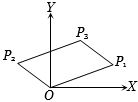
If the points ${P_1}$and ${P_2}$ represent two complex numbers ${z_1}$ and ${z_2}$, then the point ${P_3}$ represents the number