Question
If $\tan\text{A}=\text{n}\tan\text{B}$ and $\sin\text{A}=\text{m}\sin\text{B},$ prove that $\cos^2\text{A}=\frac{\big(\text{m}^2-1\big)}{\text{n}^2-1}.$

Answer

We have, $\tan\text{A}=\text{n}\tan\text{B}$
$\Rightarrow\cot\text{B}=\frac{\text{n}}{\tan\text{A}}\dots(\text{i})$
Again, $\sin\text{A}=\text{m}\sin\text{B}$
$\Rightarrow\text{cosec B}=\frac{\text{m}}{\sin\text{A}}\dots(\text{ii})$
Squaring (i) and (ii) and subtracting (ii) from (i), we get:
$\frac{\text{m}^2}{\sin^2\text{A}}-\frac{\text{n}^2}{\tan^2\text{A}}=\text{cosec}^2\text{B}-\cot^2\text{B}$
$\Rightarrow\frac{\text{m}^2}{\sin^2\text{A}}-\frac{\text{n}^2\cos}{\sin^2\text{A}}=1$
$\Rightarrow\text{m}^2-\text{n}^2\cos^2\text{A}=\sin^2\text{A}$
$\Rightarrow\text{m}^2-\text{n}^2\cos^2\text{A}=1-\cos^2\text{A}$
$\Rightarrow\text{n}^2\cos^2\text{A}-\cos^2\text{A}=\text{m}^2-1$
$\Rightarrow\cos^2\text{A}\big(\text{n}^2-1\big)=\big(\text{m}^2-1\big)$
$\Rightarrow\cos^2\text{A}=\frac{\big(\text{m}^2-1\big)}{\big(\text{n}^2-1\big)}$
$\therefore\ \cos^2\text{A}=\frac{\big(\text{m}^2-1\big)}{\big(\text{n}^2-1\big)}$

Need a full question paper?

Generate a complete, print-ready paper with questions like this in minutes — across 16+ boards, with answer keys.
Start Generating Free

Similar questions

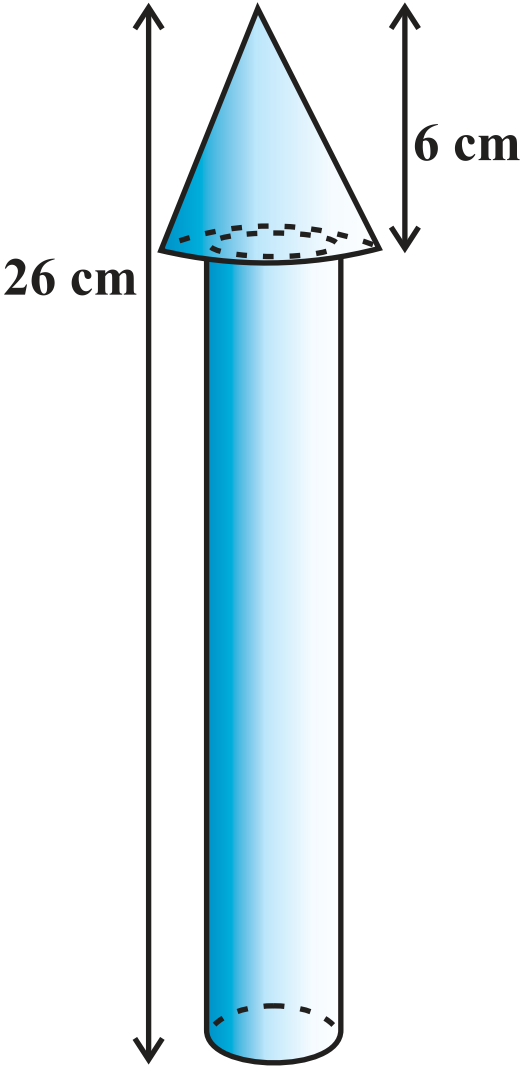
A wooden toy is in the shape of a cone mounted on a cylinder, as shown in the figure. The total height of the toy is 26cm, while the height of the conical part is 6cm. The diameter of the base of the conical part is 5cm and that of the cyliridrical part is 4cm. The conical part and the cylindrical part are respectively painted red and white. Find the area to be painted by each of these colours. $\big[$Take $\pi=\frac{22}{7}\big]$
Find the sum of first $51$ terms of an AP whose second and third terms are $14$ and $18$ respectively.
The monthly consumption of electricity (in units) of some families of a locality is given in the following frequency distribution:
Monthly consumption (in units) 140-160 160-180 180-200 200-220 220-240 240-260 260-280
Number of families 3 8 15 40 50 30 10
Prepare a 'more than type' ogive for the following frequency distribution.
Solve the following system of equations graphically:
2x - 5y + 4 = 0,
2x + y - 8 = 0
The sum of the digits of a two-digit number is 12. The number obtained by interchanging its digits exceeds the given number by 18. Find the number.
Solve the following quadratic equation:
$\frac{1}{\text{2x}-3}+\frac{1}{\text{x}-5}=1\frac{1}{9},$ $\text{x}\neq\frac{3}{2},\ 5$
Each side of an equilateral triangle is $10\ cm.$
Find:
  1. The area of the triangle.
  2. The height of the triangle.
Find the area of a trapezium whose parallel sides are $11\ m$ and $25\ m$ long, and the nonparallel sides are $15\ m$ and $13\ m$ long.
Draw a line segment AB of length 8cm. Taking A as centre, draw a circle of radius 4cm and taking B as centre, draw another circle of radius 3cm. Construct tangents to each circle from the centre of the other circle.
Solve the following quadratic equation:
$\frac{\text{x}-1}{\text{x}-2}+\frac{\text{x}-3}{\text{x}-4}=3\frac{1}{3},$
$\text{x}\neq2,4$