Question
If $\text{a}(1-\cos\theta),\text{y}=\text{a}(\theta+\sin\theta),$ prove that, $\frac{\text{d}^2\text{y}}{\text{dx}^2}=-\frac{1}{\text{a}}$ at $\theta=\frac{\pi}{2}.$

Answer

$\text{a}(1-\cos\theta),\text{y}=\text{a}(\theta+\sin\theta),$
Differentiating w.r.t.$\theta$,
$\Rightarrow\frac{\text{dx}}{\text{d}\theta}=\text{a}(0+\sin\theta);\ ...\text{Eq}\ 1$
$\frac{\text{dy}}{\text{d}\theta}\ \text{a}(1+\cos\theta)\ ...\text{Eq}\ 2$
Dividing (2) by (1)
$\Rightarrow\frac{\text{dy}}{\text{dx}}=\frac{\text{dy}}{\text{d}\theta}\times\frac{\text{d}\theta}{\text{dx}}=\frac{\text{a}(1+\cos\theta)}{\text{a}\sin\theta}$
Differentiating w.r.t.$\theta$,
$\Rightarrow\frac{\text{d}\Big(\frac{\text{dy}}{\text{dx}}\Big)}{\text{d}\theta}=\frac{\sin\theta(0-\sin\theta)-(1+\cos\theta)\cos\theta}{\sin^2\theta}...(3)$
$=-\frac{\sin^2\theta-\cos\theta-\cos^2\theta}{\sin^2\theta}$
$=-\frac{(1+\cos\theta)}{\sin^2\theta}...(4 )$
dividing (4) by (3)
$\Rightarrow\frac{\text{d}^2\text{y}}{\text{dx}^2}=-\frac{(1+\cos\theta)}{\sin^2\theta\times\text{a}\sin\theta}$
putting $\theta=\frac{\pi}{2}$
$\Rightarrow\frac{\text{d}^2\text{y}}{\text{dx}^2}=-\frac{1}{\text{a}}$
Hence proved

Need a full question paper?

Generate a complete, print-ready paper with questions like this in minutes — across 16+ boards, with answer keys.
Start Generating Free

Similar questions

Find the equation of the plane through the points $(2, 1, 0), (3, -2, -2)$ and $(3, 1, 7)$.
Assume that each born child is equally likely to be a boy or a girl. If a family has two children, what is the conditional probability that both are girls? Given that
  1. The youngest is a girl.
  2. Atleast one is a girl.
A bag contains $4$ red and $4$ black balls, another bag contains $2$ red and $6$ black balls. One of the two bags is selected at random and a ball is drawn from the bag which is found to be red. Find the probability that the ball is drawn from the first bag.
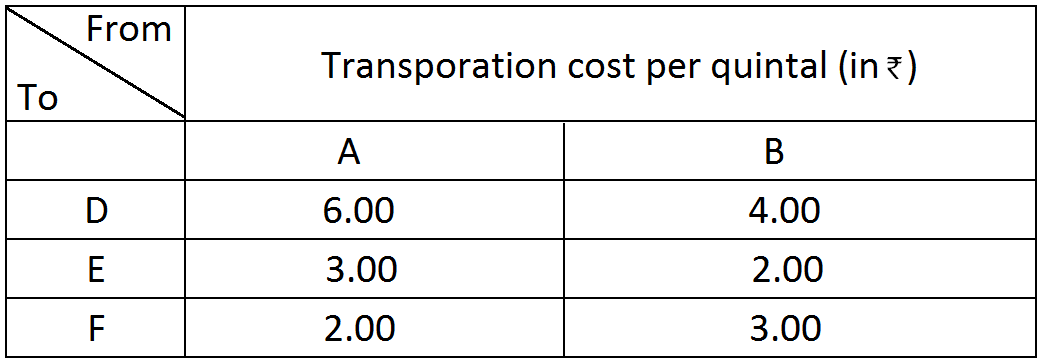
Tow godowns,$ A$   and $B,$ have grain storage capacity of $100$ quintals and $50$ quintals respectively. They supply to $3$ ration shops, $D,\ E$ and $F$, whose requirements are $60,\ 50$ and $40$ quintals respectively. The cost of transportation per quintal from the godowns to the shops are given in the following table:

How should the supplies be transported in order that the transportation cost is minimum?
Show that the points A(1, -2, -8), B(5, 0, -2) and C(11, 3, 7) are collinear, and find the ratio in which B divides AC.
If $\text{y}=(\cot^{-1}\text{x})^2$ prove that $\text{y}^2(\text{x}^2+1)^2+2\text{x}(\text{x}^2+1)\text{y}_1=2.$
Solve the equation
$\cos^{-1}\frac{\text{a}}{\text{x}}-\cos^{-1}\frac{\text{b}}{\text{x}}=\cos^{-1}\frac{1}{\text{b}}-\cos^{-1}\frac{1}{\text{b}}-\cos^{-1}\frac{1}{\text{a}}$
Solve the differential equation: $\frac{\text{dy}}{\text{dx}}-\frac{2\text{x}}{1+\text{x}^2}\text{y}=\text{x}^2+2$
Two numbers are selected at random (without replacement) from positive integers 2, 3, 4, 5, 6 and 7. Let X denote the larger of the two numbers obtained. Find the mean and variance of the probability distribution of X.
A firm manufactures headache pills in two sizes A and B. Size A contains 2 grains of aspirin, 5 grains of bicarbonate and 1 grain of codeine; size B contains 1 grain of aspirin, 8 grains of bicarbonate and 66 grains of codeine. It has been found by users that it requires at least 12 grains of aspirin, 7.4 grains of bicarbonate and 24 grains of codeine for providing immediate effects. Determine graphically the least number of pills a patient should have to get immediate relief. Determine also the quantity of codeine consumed by patient