Question
If $\text{A}=\begin{bmatrix}1&0\\0&1\end{bmatrix},\text{B}\begin{bmatrix}1&0\\0&-1\end{bmatrix}$ and $\text{C}=\begin{bmatrix}0&1\\1&0\end{bmatrix},$ then show that $A^2 = B^2 = C^2 = l_2$.

Answer

Here,
$\text{A}^2=\text{AA}$
$\Rightarrow\text{A}^2=\begin{bmatrix}1&0\\0&1\end{bmatrix}\begin{bmatrix}1&0\\0&1\end{bmatrix}$
$\Rightarrow\text{A}^2=\begin{bmatrix}1+0&0+0\\0+0&0+1\end{bmatrix}$
$\Rightarrow\text{A}^2=\begin{bmatrix}1&0\\0&1\end{bmatrix}\ \dots(1)$
$\text{B}^2=\text{BB}$
$\Rightarrow\text{B}^2=\begin{bmatrix}1&0\\0&-1\end{bmatrix}\begin{bmatrix}1&0\\0&-1\end{bmatrix}$
$\Rightarrow\text{B}^2=\begin{bmatrix}1+0&0-0\\0-0&0+1\end{bmatrix}$
$\Rightarrow\text{B}^2=\begin{bmatrix}1&0\\0&1\end{bmatrix}\ \dots(2)$
$\text{C}^2=\text{CC}$
$\Rightarrow\text{C}^2=\begin{bmatrix}0&1\\1&0\end{bmatrix}\begin{bmatrix}0&1\\1&0\end{bmatrix}$
$\Rightarrow\text{C}^2=\begin{bmatrix}0+1&0+0\\0+0&1+0\end{bmatrix}$
$\Rightarrow\text{C}^2=\begin{bmatrix}1&0\\0&1\end{bmatrix}\ \dots(3)$
We know,
$\text{I}_2=\begin{bmatrix}1&0\\0&1\end{bmatrix}\ \dots(4)$
$\Rightarrow\text{A}^2=\text{B}^2=\text{C}^2=\text{I}^2$ [From eqs. (1), (2), (3) and (4)]

Need a full question paper?

Generate a complete, print-ready paper with questions like this in minutes — across 16+ boards, with answer keys.
Start Generating Free

Similar questions

If $\text{x}=\text{a}(\theta-\sin\theta),\text{y}=\text{a}(1+\cos\theta)$ find $\frac{\text{d}^2\text{y}}{\text{dx}^2}$
In the following, determine the values of constants involved in the definition so that the given function is continuous:
$\text{f(x)}=\begin{cases}4,&\text{if }\text{ x}\leq-1\\\text{ax}^2+\text{b},&\text{if }-1<\text{ x}<0\\\cos\text{x},&\text{if }\text{ x}\geq0\end{cases}$
Examine that sin |x| is a continuous function.
If $\text{A}^\text{T}=\begin{bmatrix}3&4\\-1&2\\0&1\end{bmatrix}$ and $\text{B}=\begin{bmatrix}-1&2&1\\1&2&3\end{bmatrix},$ find $A^T - B^T$.
If $\text{x}\sqrt{1+\text{y}}+\text{y}\sqrt{1+\text{x}}=0,$ prove that $(1+\text{x})^2\frac{\text{dx}}{\text{dx}}+1=0$
Evaluate the following integrals:
$\int\frac{1}{\sin\text{x}+\sin2\text{x}}\ \text{dx}$
Solve the following differential equation:
$\frac{\text{dy}}{\text{dx}} = \tan(\text{x}+\text{y})$
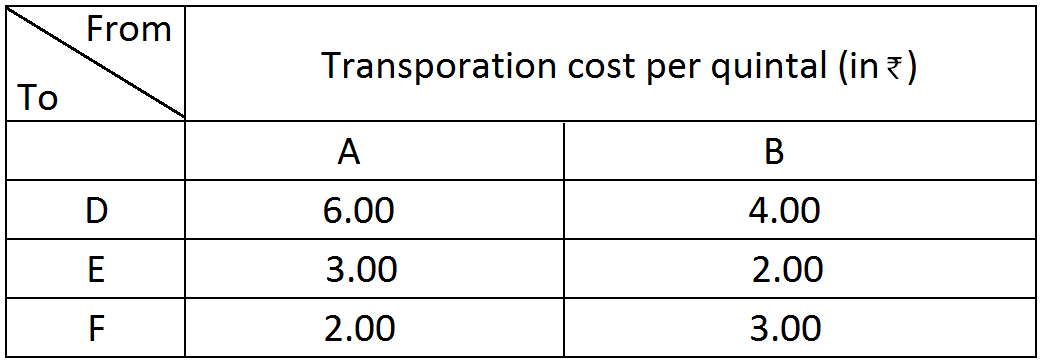
Tow godowns, A and B, have grain storage capacity of 100 quintals and 50 quintals respectively. They supply to 3 ration shops, D, E and F, whose requirements are 60, 50 and 40 quintals respectively. The cost of transportation per quintal from the godowns to the shops are given in the following table:

How should the supplies be transported in order that the transportation cost is minimum?
A rectangular sheet of tin $45$cm by $24$cm is to be made into a box without top, in cutting off squares from each corners and folding up the flaps. What should be the side of the square to be cut off so that the volume of the box is maximum possible?
If f'(x) = x + b, f'(1) = 5, f'(2) = 13, find f'(x).