Question
If $\text{a}\neq\text{b}\neq\text{c},$ prove that the points $(a, a^2), (b, b^2), (c, c^2)$ can never be collinear.

Answer

Let $(a, a^2), (b, b^2), (c, c^2)$ he given points. Three points are collinear if area enclosed by three points is zero. Area of $\triangle\text{ABC}=\frac{1}{2}|\text{x}_1(\text{y}_2-\text{y}_3)+\text{x}_2(\text{y}_3-\text{y}_1)+\text{x}_3(\text{y}_1-\text{y}_2)|$ $=\frac{1}{2}|\text{a}(\text{b}^2-\text{c}^2)+\text{b}(\text{c}^2-\text{a}^2)+\text{c}(\text{a}^2-\text{b}^2)|$ $=\frac{1}{2}|\text{ab}^2-\text{ac}^2+\text{bc}^2-\text{a}^2\text{b}+\text{a}^2\text{c}-\text{b}^2\text{c}|$ $=\frac{1}{2}|(\text{a}^2\text{c}-\text{a}^2\text{b})+(\text{ab}^2-\text{ac}^2)+(\text{bc}^2-\text{b}^2\text{c})|$ $=\frac{1}{2}|(-\text{a}^2)(\text{b}-\text{c})+\text{a}(\text{b}^2-\text{c}^2)-\text{bc}(\text{b}-\text{c})|$ $=\frac{1}{2}|(\text{b}-\text{c})(-\text{a}^2+\text{a}(\text{b}+\text{c})-\text{bc})|$$=\frac{1}{2}|(\text{b}-\text{c})(-\text{a}^2+\text{ab}+\text{ac}-\text{bc})|$
$=\frac{1}{2}|(\text{b}-\text{c})[(-\text{a})(\text{a}-\text{b})+\text{c}(\text{a}-\text{b})]|$
$=\frac{1}{2}|(\text{b}-\text{c})(\text{c}-\text{a})(\text{a}-\text{b})|$
It is given that $\text{a}\neq\text{b}\neq\text{c}$ Hence area of triangle made by three points is never zero. Hence given points are never collinear.

Need a full question paper?

Generate a complete, print-ready paper with questions like this in minutes — across 16+ boards, with answer keys.
Start Generating Free

Similar questions

If P(9a - 2, -b) divides the line segment joining A(3a + 1, -3) and B(8a, 5) in the ratio 3 : 1, find the values of a and b.
A(6, 1), B(8, 2) and C(9, 4) are the vertices of a parallelogram ABCD. If E is the midpoint of DC, find the area of $\triangle\text{ADE}.$
For the following statments state whether true (T) or false(F):If O is any point inside a rectangle ABCD then $OA^2 + OC^2 = OB^2 + OD^2$​​​​​​​
A metallic bucket, open at the top, of height 24cm is in the form of the frustum of a cone, the radii of whose lower and upper circular ends are 7cm and 14cm, respectively. Find
  1. The volume of water which can completely fill the bucket,
  2. The area of the metal sheet used to make the bucket.
From the top of a tower h m high, the angles of depression of two objects, which are in line with the foot of the tower are α and $\beta(\beta>\alpha).$ Find the distance between the two objects.
Find all the zeros of the polynomial $(2x^4 - 11x^3 + 7x^2 + 13x)$, it being given that two if its zeros are $3+\sqrt2$ and $3-\sqrt2.$
Find the distance between the points:
$\text{P}(\text{a}\sin\alpha,\text{a}\cos\alpha)$ and $\text{Q}(\text{a}\cos\alpha, -\text{a}\sin\alpha)$
The first term of an AP is p and its common difference is q. Find its $10^{th}$​​​​​​​ term.
If the sum of first $6$ terms of an $A.P$. is $36$ and that of the first $16$ terms is $256,$ find the sum of first $10$ terms.
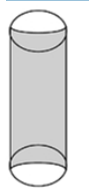
A wooden article was made by scooping out a hemisphere from each end of a solid cylinder as shown in the figure. If the height of the cylinder is $10 \ cm$ and its base is of radius $3.5 \ cm,$ find the total surface area of the article.
Image