Question
If $a \neq b \neq c$, prove that $\left(a, a^2\right),\left(b . b^2\right),(0,0)$ will not be collinear.
Answer

Missing

Need a full question paper?

Generate a complete, print-ready paper with questions like this in minutes — across 16+ boards, with answer keys.

Start Generating Free

Similar questions

A right triangle whose sides are 15cm and 20cm (other than hypotenuse), is made to revolve about its hypotenuse. Find the volume and surface area of the double cone so formed. (Choose value of $\pi$ as found appropriate)
Find the sum of,
All 3 - digit natural numbers which are divisible by 13.
For the following statments state whether true (T) or false(F):
The sum of the squares on the sides of a rhombus is equal to the sum of the squares on its diagonals.
Divide 27 into two parts such that the sum of their reciprocals is $\frac{3}{20}.$
Find the distance between the points:
$\text{P}(\text{a}\sin\alpha,\text{a}\cos\alpha)$ and $\text{Q}(\text{a}\cos\alpha, -\text{a}\sin\alpha)$
If $\text{x}=\text{a}\sec\theta+\text{b}\tan\theta$ and $\text{y}=\text{a}\tan\theta-\text{b}\sec\theta,$ prove that $\big(\text{x}^2+\text{y}^2\big)=\big(\text{a}^2-\text{b}^2\big).$
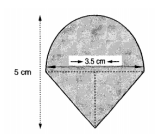
Rasheed got a playing top $($lattu$)$ as his birthday present, which surprisingly had no colour on it. He wanted to colour it with his crayons. The top is shaped like a cone surmounted by a hemisphere. The entire top is $5 \ cm$ in height and the diameter of the top is $3.5 \ cm$ . Find the area he has to colour. $($Take $\pi=\frac{22}{7} )$.
Image
The length of a line segment is of 10 units and the coordinates of one end-point are (2, -3). If the abscissa of the other end is 10, find the ordinate of the other end.
Prove the following identities:
$\frac{\sin\theta}{(1+\cos\theta)}+\frac{(1+\cos^2\theta)}{\sin\theta}=2\text{cosec}\theta$
A solid right circular cone of height 120cm and radius 60cm is placed in a right circular cylinder full of water of height 180cm such that it touches the bottom. Find the volume of water left in the cylinder, if the radius of the cylinder is equal to the radius of the cone.