Question
If $\text{A}=[\text{a}_\text{ij}]_{\text{m}\times\text{n}}$ and $\text{B}=[\text{b}_\text{ij}]_{\text{m}\times\text{n}}$ are two matrices, then A ± B is of order m × n and is defined as:
$(\text{A}\pm\text{B})_\text{ij}=\text{a}_\text{ij}\pm\text{b}_\text{ij},$ where i = 1, 2, ............. , m and j = 1, 2, .......... , n
If $\text{A}=[\text{a}_\text{ij}]_{\text{m}\times\text{n}}$ and $\text{B}=[\text{b}_\text{ij}]_{\text{n}\times\text{p}}$ are two matrices, then AB is of order m × p and is defined as:
$(\text{A}\text{B})_\text{ik}=\sum\limits_\text{r=1}^\text{n}\text{a}_\text{ir}\text{b}_\text{rk}=\text{a}_\text{i1}\text{b}_\text{1k}+\text{a}_\text{i2}\text{b}_\text{2k}+.....+\text{a}_\text{in}\text{b}_\text{nk}$
Consider $\text{A}=\begin{bmatrix}2&-1\\3&4\end{bmatrix},\ \text{B}=\begin{bmatrix}5&2\\7&4\end{bmatrix},\ \text{B}=\begin{bmatrix}2&5\\3&8\end{bmatrix} \text{And}\ \text{D}=\begin{bmatrix}\text{a}&\text{b}\\\text{c}&\text{d}\end{bmatrix}$
Using the concept of matrices answer the following questions.
  1. Find the product AB.
  1. $\begin{bmatrix}3&0\\43&22\end{bmatrix}$
  2. $\begin{bmatrix}0&3\\22&43\end{bmatrix}$
  3. $\begin{bmatrix}43&22\\0&3\end{bmatrix}$
  4. $\begin{bmatrix}22&43\\3&0\end{bmatrix}$
  1. If A and Bare any other two matrices such that AB exists, then
  1. BA does not exist.
  2. BA will be equal to AB.
  3. BA may or may not exist.
  4. None of these.
  1. Find the values of a and c in the matrix D such than CD - AB = 0.
  1. a = 77, c = -191
  2. a = -191, c = 77
  3. a = 191, c = 77
  4. a = 91, c = 70
  1. Find the values of band din the matrix D such that CD - AB = 0.
  1. b = 44, d = -110
  2. b = 110, d = 44
  3. b = -110, d = 44
  4. b = -44, d = 110
  1. Find B + D.
  1. $\begin{bmatrix}80&200\\115&105\end{bmatrix}$
  2. $\begin{bmatrix}84&48\\180&181\end{bmatrix}$
  3. $\begin{bmatrix}186&108\\-84&-48\end{bmatrix}$
  4. $\begin{bmatrix}-186&-108\\84&48\end{bmatrix}$
Answer

  1. (a) $\begin{bmatrix}3&0\\43&22\end{bmatrix}$
Solution:

$\text{AB}=\begin{bmatrix}2&-1\\3&4\end{bmatrix}\begin{bmatrix}5&2\\7&4\end{bmatrix}$

$=\begin{bmatrix}10-7&4-4\\15+28&6+16\end{bmatrix}=\begin{bmatrix}3&0\\43&22\end{bmatrix}$
  1. (c) BA may or may not exist.
  2. (b) a = -191, c = 77
Solution:

We have, CD - AB = 0

$\Rightarrow\begin{bmatrix}2&5\\3&8\end{bmatrix}\begin{bmatrix}\text{a}&\text{b}\\\text{c}&\text{d}\end{bmatrix}-\begin{bmatrix}3&0\\43&22\end{bmatrix}=\begin{bmatrix}0&0\\0&0\end{bmatrix}$

$\Rightarrow\begin{bmatrix}2\text{a}+5\text{c}&2\text{b}+5\text{d}\\3\text{a}+8\text{c}&3\text{b}+8\text{d}\end{bmatrix}-\begin{bmatrix}3&0\\43&22\end{bmatrix}=\begin{bmatrix}0&0\\0&0\end{bmatrix}$

$\Rightarrow\begin{bmatrix}2\text{a}+5\text{c}-3&2\text{b}+5\text{d}\\3\text{a}+8\text{c}-43&3\text{b}+8\text{d}-22\end{bmatrix}=\begin{bmatrix}0&0\\0&0\end{bmatrix}$

By equality of matrices, we get

2a + 5c - 3 = 0 .......... (i)

3a + 8c - 43 = 0 ........... (ii)

2b+ 5d = 0 ........... (iii)

3b + 8d - 22 = 0 ............. (iv)
  1. (c) b = -110, d = 44
Solution:

Solving (iii) and (iv), we get b = -110, d = 44
  1. (d) $\begin{bmatrix}-186&-108\\84&48\end{bmatrix}$

Solution:

We have, $\text{B+D}=\begin{bmatrix}5&2\\7&4\end{bmatrix}+\begin{bmatrix}-191&-110\\77&44\end{bmatrix}$

$=\begin{bmatrix}-186&-108\\84&48\end{bmatrix}$
Need a full question paper?

Generate a complete, print-ready paper with questions like this in minutes — across 16+ boards, with answer keys.

Start Generating Free

Similar questions

Read the following passage and answer the questions given below.

Image

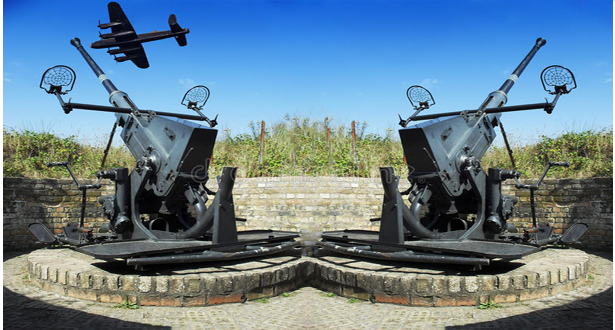
There are two antiaircraft guns, named as A and B. The probabilities that the shell fired from them hits an airplane are 0.3 and 0.2 respectively. Both of them fired one shell at an airplane at the same time.
(i) What is the probability that the shell fired from exactly one of them hit the plane?
(ii) If it is known that the shell fired from exactly one of them hit the plane, then what is the probability that it was fired from B?

It is known that, if the interest is compounded continuously, the principal changes at the rate equal to the product of the rate of bank interest per annum and the principal. Let $P$ denotes the principal at any time t and rate of interest be r% per annum.

Based on the above information, answer the following question.
  1. Find the value of $\frac{\text{dP}}{\text{dt}}.$
  1. $\frac{\text{Pr}}{1000}$
  2. $\frac{\text{Pr}}{100}$
  3. $\frac{\text{Pr}}{10}$
  4. $\text{Pr}$
  1. If $P_0$ be the initial principal, then find the solution of differential equation formed in given situation.
  1. $\log\Big(\frac{\text{P}}{\text{P}_0}\Big)=\frac{\text{rt}}{100}$
  2. $\log\Big(\frac{\text{P}}{\text{P}_0}\Big)=\frac{\text{rt}}{10}$
  3. $\log\Big(\frac{\text{P}}{\text{P}_0}\Big)=\text{rt}$
  4. $\log\Big(\frac{\text{P}}{\text{P}_0}\Big)=100\text{rt}$
  1. If the interest is compounded continuously at 5% per annum, in how many years will $₹\ 100$ double itself?
  1. $12.728$ years
  2. $14.789$ years
  3. $13.862$ years
  4. $15.872$ years
  1. At what interest rate will $₹\ 100$ double itself in 10 years? $(\log_\text{e}2 = 0.6931 ).$
  1. $9.66\%$
  2. $8.239\%$
  3. $7.341\%$
  4. $6.931\%$
  1. How much will $₹\ 1000$ be worth at 5% interest after $10$ years$?$ $(e^{0.5} = 1.648).$
  1. $₹\ 1648$
  2. $₹\ 1500$
  3. $₹\ 1664$
  4. $₹\ 1572$
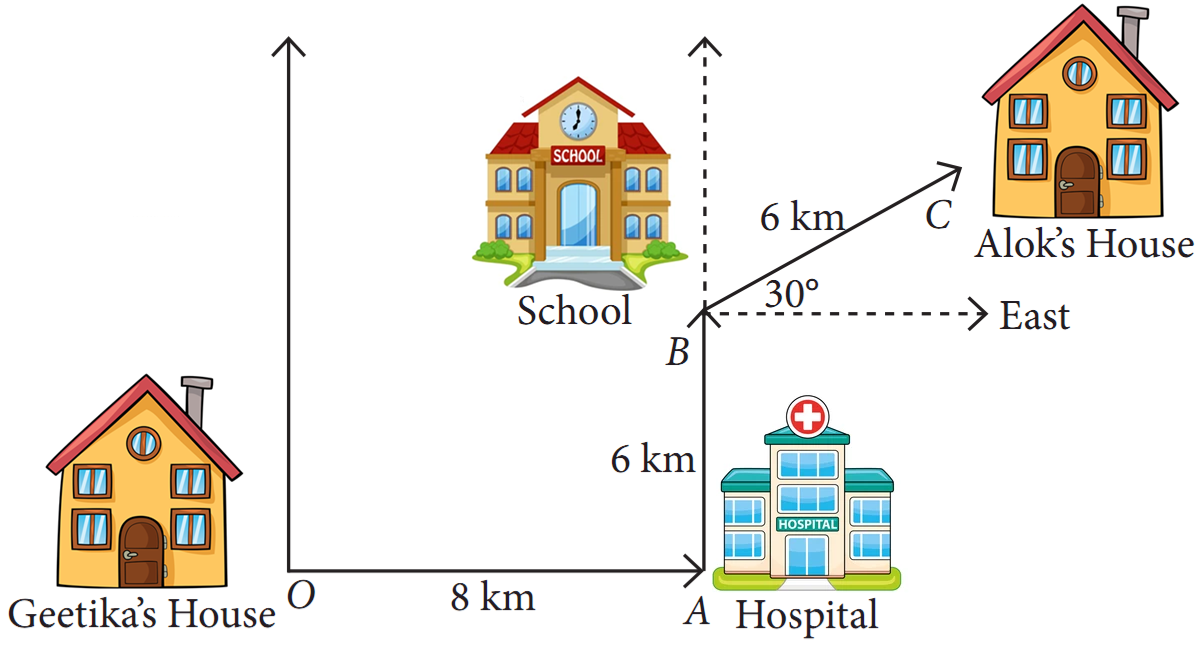
Geetika's house is situated at Shalimar Bagh at point O, for going to Alok's house she first travels 8km by bus in the East. Here at point A, a hospital is situated. From Hospital, Geetika takes an auto and goes 6km in the North, here at point B school is situated. From school, she travels by bus to reach Alok's house which is at 30º East, 6km from point B.

Based on the above information, answer the following questions.
  1. What is the vector distance between Geetika's house and school?
  1. $8\hat{\text{i}}-6\hat{\text{j}}$
  2. $8\hat{\text{i}}+6\hat{\text{j}}$
  3. $8\hat{\text{i}}$
  4. $6\hat{\text{j}}$
  1. How much distance Geetika travels to reach school?
  1. 14km
  2. 15km
  3. 16km
  4. 17km
  1. What is the vector distance from school to Alok's house?
  1. $\sqrt{3}\hat{\text{i}}+\hat{\text{j}}$
  2. $3\sqrt{3}\hat{\text{i}}+3\hat{\text{j}}$
  3. $6\hat{\text{i}}$
  4. $6\hat{\text{j}}$
  1. What is the vector distance from Geetika's house to Alok's house?
  1. $(8+3\sqrt{3})\hat{\text{i}}+9\hat{\text{j}}$
  2. $4\hat{\text{i}}+6\hat{\text{j}}$
  3. $15\hat{\text{i}}$
  4. $16\hat{\text{j}}$
  1. What is the total distance travelled by Geetika from her house to Alok's house?
  1. 19km
  2. 20km
  3. 21km
  4. 22km
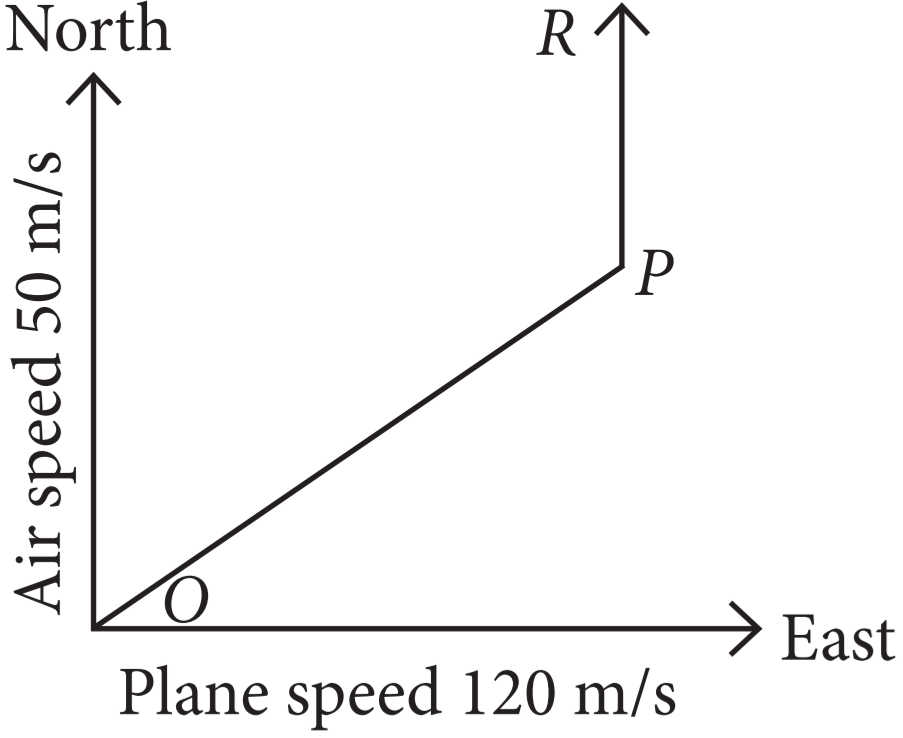
A plane started from airport situated at O with a velocity of 120m/s towards east. Air is blowing at a velocity of 50m/ s towards the north as shown in the figure.
The plane travelled 1hr in OP direction with the resultant velocity. From P to R the plane travelled 1hr keeping velocity of 120m/s and finally landed at R.

Based on the above information, answer the following questions.
  1. What is the resultant velocity from O to P?
  1. 100m/ s
  2. 130m/ s
  3. 126m/ s
  4. 180m/ s
  1. What is the direction of travel of plane from O to P with East?
  1. $\tan^{-1}\Big(\frac{5}{12}\Big)$
  2. $\tan^{-1}\Big(\frac{12}{3}\Big)$
  3. 50
  4. 80
  1. What is the displacement from O to P?
  1. 600km
  2. 468km
  3. 532km
  4. 500km
  1. What is the resultant velocity from P to R?
  1. 120m/ s
  2. 70m/ s
  3. 170m/ s
  4. 200m/ s
  1. What is the displacement from P to R?
  1. 450km
  2. 532km
  3. 610km
  4. 612km
Mr. Sahil is the owner of a high rise residential society having 50 apartments. When he set rent at ₹ 10000/ month, all apartments are rented. If he increases rent by ₹ 250/ month, one fewer apartment is rented. The maintenance cost for each occupied unit is ₹ 500/ month.

Based on the above information, answer the following questions.
  1. If P is the rent price per apartment and N is the number of rented apartment, then profit is given by.
  1. NP
  2. (N - 500)P
  3. N(P - 500)
  4. None of these
  1. If x represent the number of apartments which are not rented, then the profit expressed as a function of x is.
  1. (50 - x)(38 + x)
  2. (50 + x)(38 - x)
  3. 250(50 - x)(38 + x)
  4. 250(50 + x)(38 - x)
  1. If P = 10500, then N =
  1. 47
  2. 48
  3. 49
  4. 50
  1. If P = 11,000, then the profit is.
  1. ₹ 4,83,000
  2. ₹ 5,00,000
  3. ₹ 5,05,000
  4. ₹ 6,50,000
  1. The rent that maximizes the total amount of profit is.
  1. ₹ 11000
  2. ₹ 11500
  3. ₹ 15800
  4. ₹ 16500
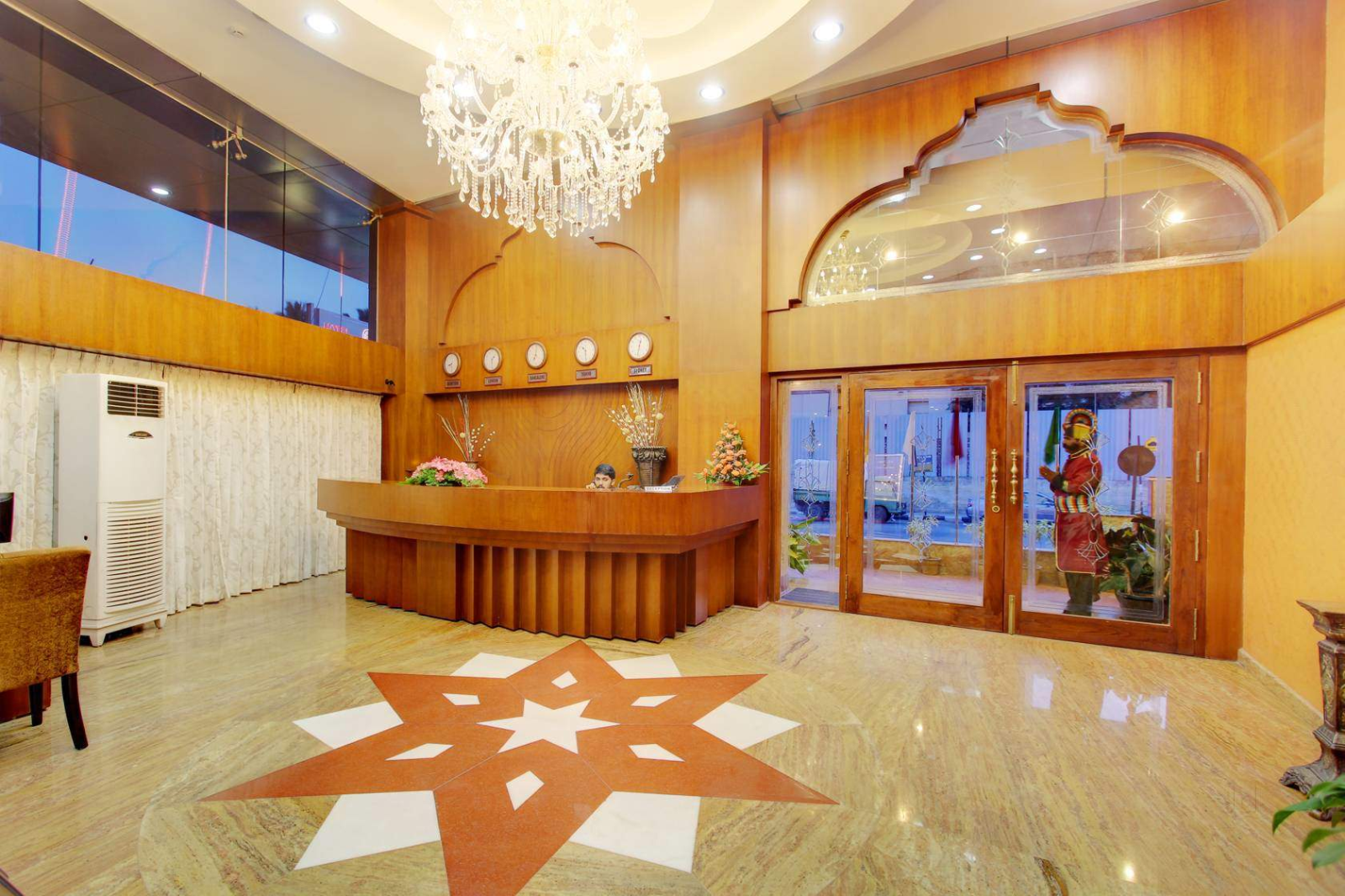
Suppose the floor of a hotel is made up of mirror polished Kota stone. Also, there is a large crystal chandelier attached at the ceiling of the hotel. Consider the floor of the hotel as a plane having equation $x - 2y + 2z = 3$ and crystal chandelier at the point $(3, -2, 1)$.

Based on the above information, answer the following questions.
  1. The d.r'.s of the perpendicular from the point $(3, -2, 1)$ to the plane $x - 2y + 2z = 3,$ is:
  1. $< 1, 2, 2 >$
  2. $< 1, -2, 2 >$
  3. $< 2, 1, 2 >$
  4. $< 2, -1, 2 >$
  1. The length of the perpendicular from the point $(3, -2, 1)$ to the plane $x - 2y + 2z = 3,$ is:
  1. $\frac{2}{3}\text{units}$
  2. $3$ units
  3. $2$ units
  4. None of these
  1. The equation of the perpendicular from the point $(3, -2, 1)$ to the plane $x - 2y + 2z = 3$, is:
  1. $\frac{\text{x}-3}{1}=\frac{\text{y}-2}{-2}=\frac{\text{z}-1}{2}$
  2. $\frac{\text{x}-3}{1}=\frac{\text{y}+2}{-2}=\frac{\text{z}-1}{2}$
  3. $\frac{\text{x}+3}{1}=\frac{\text{y}+2}{-2}=\frac{\text{z}-1}{2}$
  4. None of these
  1. The equation of plane parallel to the plane $x - 2y + 2z = 3,$ which is at a unit distance from the point $(3, -2, 1)$ is:
  1. $x - 2y + 2z = 0$
  2. $x - 2y + 2z = 6$
  3. $x - 2y + 2z = 12$
  4. Both $(b)$ and $(c)$
  1. The image of the point $(3, -2, 1)$ in the given plane is:
  1. $\Big(\frac{5}{3},\frac{2}{3},\frac{-5}{3}\Big)$
  2. $\Big(\frac{-5}{3},\frac{-2}{3},\frac{5}{3}\Big)$
  3. $\Big(\frac{-5}{3},\frac{2}{3},\frac{5}{3}\Big)$
  4. None of these
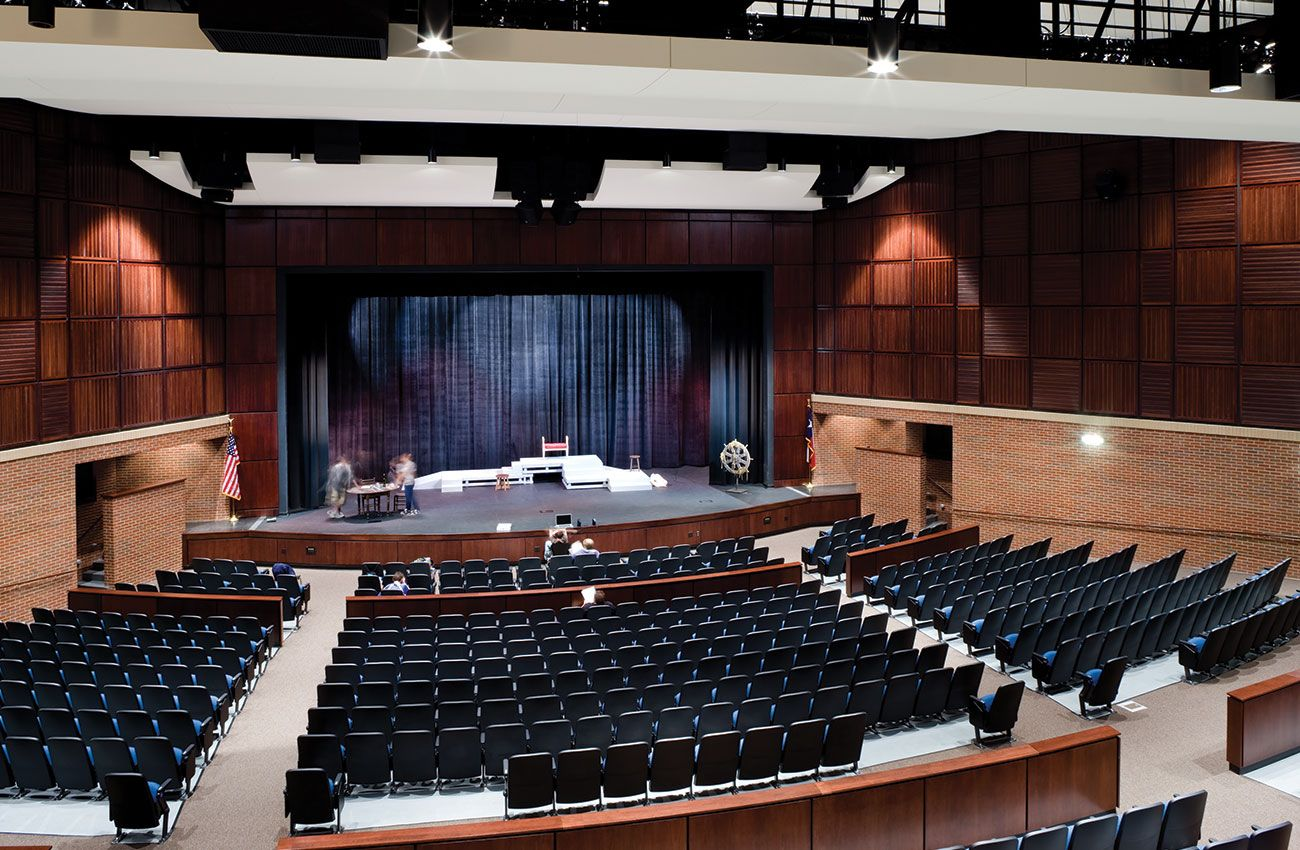
An architecture design a auditorium for a school for its cultural activities. The floor of the auditorium is rectangular in shape and has a fixed perimeter P.

Based on the above information, answer the following questions.
  1. If x and y represents the length and breadth of the rectangular region, then relation between the variable is.
  1. $x + y = P$
  2. $x^2 + y^2 = P^2$
  3. $2(x + y) = P$
  4. $x + 2y = P$
  1. The area (A) of the rectangular region, as a function of x, can be expressed as.
  1. $\text{A}=\text{px}+\frac{\text{x}}{2}$
  2. $\text{A}=\frac{\text{px}+\text{x}^2}{2}$
  3. $\text{A}=\frac{\text{px}-\text{2x}^2}{2}$
  4. $\text{A}=\frac{\text{x}^2}{2}+\text{px}^2$
  1. School's manager is interested in maximising the area of floor 'A' for this to be happen, the value of x should be.
  1. $\text{P}$
  2. $\frac{\text{P}}{2}$
  3. $\frac{\text{P}}{3}$
  4. $\frac{\text{P}}{4}$
  1. The value of y, for which the area of floor is maximum, is.
  1. $\frac{\text{P}}{2}$
  2. $\frac{\text{P}}{3}$
  3. $\frac{\text{P}}{4}$
  4. $\frac{\text{P}}{16}$
  1. Maximum area of floor is.
  1. $\frac{\text{P}^2}{16}$
  2. $\frac{\text{P}^2}{64}$
  3. $\frac{\text{P}^2}{4}$
  4. $\frac{\text{P}^2}{28}$
Let f : A → B and g : B → C be two functions defined on non-empty sets A, B, C, then gof : A → C be is called the composition of f and g defined as, $\text{gof}(\text{x})=\text{g}\{\text{f(x)}\}\forall\text{ x }\in\text{ A}.$ Consider the functions $\text{f}(\text{x})=\begin{cases}\sin\text{x},&\text{x}\geq0\\1-\cos\text{x},&\text{x}\leq0\end{cases},\text{g}(\text{x})=\text{e}^\text{x}$ and then answer the following questions.
  1. The function gof(x) is defined as:
  1. $\text{gof}(\text{x})=\begin{cases}\text{e}^\text{x}&,\text{x}\geq0\\1-\text{e}^{\cos\text{x}}&,\text{x}\leq0\end{cases}$
  2. $\text{gof}(\text{x})=\begin{cases}\text{e}^{\sin\text{x}}&,\text{x}\leq0\\\text{e}^{1-\cos\text{x}}&,\text{x}\geq0\end{cases}$
  3. $\text{gof}(\text{x})=\begin{cases}\text{e}^{\sin\text{x}}&,\text{x}\leq0\\1-\text{e}^{\cos\text{x}}&,\text{x}\geq0\end{cases}$
  4. $\text{gof}(\text{x})=\begin{cases}\text{e}^{\sin\text{x}}&,\text{x}\geq0\\\text{e}^{1-\cos\text{x}}&,\text{x}\leq0\end{cases}$
  1. $\frac{\text{d}}{\text{dx}}\{\text{gof}(\text{x})\}=$
  1. $[\text{gof}(\text{x})]'=\begin{cases}\cos\text{x}\cdot\text{e}^{\sin\text{x}}&,\text{x}\geq0\\\text{e}^{1-\cos\text{x}}\cdot\sin\text{x}&,\text{x}\leq0\end{cases}$
  2. $[\text{gof}(\text{x})]'=\begin{cases}\cos\text{x}\cdot\text{e}^{\sin\text{x}}&,\text{x}\geq0\\-\sin\text{x}\cdot\text{e}^{1-\cos\text{x}}&,\text{x}\leq0\end{cases}$
  3. $[\text{gof}(\text{x})]'=\begin{cases}\cos\text{x}\cdot\text{e}^{\sin\text{x}}&,\text{x}\geq0\\\sin\text{x}\cdot({1-\cos\text{x}})&,\text{x}\leq0\end{cases}$
  4. $[\text{gof}(\text{x})]'=\begin{cases}\cos\text{x}\cdot\text{e}^{\sin\text{x}}&,\text{x}\geq0(1-{\sin\text{x}})\cdot\text{e}^{1-\cos\text{x}}&,\text{x}\leq0\end{cases}$
  1. R.H.D. of gof(x) at $x = 0$ is:
  1. $0$
  2. $1$
  3. $-1$
  4. $2$
  1. L.H.D. of gof(x) at $x = 0$ is:
  1. $0$
  2. $1$
  3. $-1$
  4. $2$
  1. The value of f'(x) at $\text{x}=\frac{\pi}{4}$ is:
  1. $\frac{1}{9}$
  2. $\frac{1}{\sqrt2}$
  3. $\frac{1}{2}$
  4. Not defined.
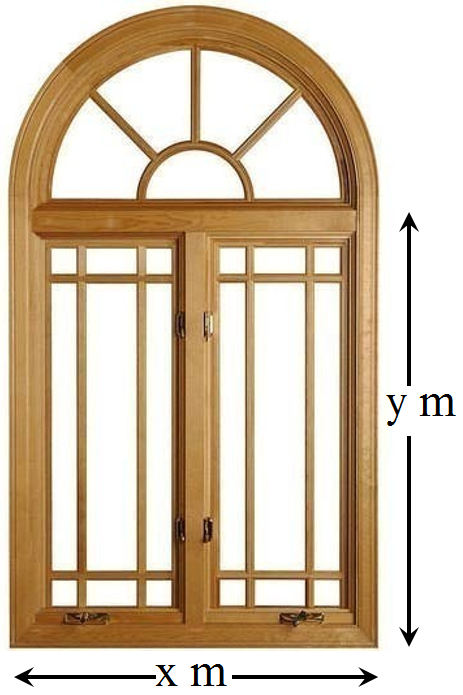
Rohan, a student of class XII, visited his uncle's flat with his father. He observe that the window of the house is in the form of a rectangle surmounted by a semicircular opening having perimeter 10m as shown in the figure.

Based on the above information, answer the following questions.
  1. If x and y represents the length and breadth of the rectangular region, then relation between x and y can be represented as.
  1. $\text{x}+\text{y}+\frac{\pi}{2}=10$
  2. $\text{x}+\text{2y}+\frac{\pi\text{x}}{2}=10$
  3. $\text{2x}+\text{2y}=10$
  4. $\text{x}+\text{2y}+\frac{\pi}{2}=10$
  1. The area (A) of the window can be given by.
  1. $\text{A}=\text{x}-\frac{\text{x}^3}{8}-\frac{\text{x}^2}{2}$
  2. $\text{A}=\text{5x}-\frac{\text{x}^2}{8}-\frac{\pi\text{x}^2}{8}$
  3. $\text{A}=\text{x}+\frac{\pi\text{x}^3}{8}-\frac{\text{3x}^2}{8}$
  4. $\text{A}=\text{5x}+\frac{\text{x}^3}{2}+\frac{\pi\text{x}^2}{8}$
  1. Rohan is interested in maximizing the area of the whole window, for this to happen, the value of x should be.
  1. $\frac{10}{2-\pi}$
  2. $\frac{20}{4-\pi}$
  3. $\frac{20}{4+\pi}$
  4. $\frac{10}{2+\pi}$
  1. Maximum area of the window is.
  1. $\frac{30}{4+\pi}$
  2. $\frac{30}{4-\pi}$
  3. $\frac{50}{4-\pi}$
  4. $\frac{50}{4+\pi}$
  1. For maximum value of A, the breadth of rectangular part of the window is.
  1. $\frac{10}{4+\pi}$
  2. $\frac{10}{4-\pi}$
  3. $\frac{20}{4+\pi}$
  4. $\frac{20}{4-\pi}$
Mr. Ajay is taking up subjects of mathematics, physics, and chemistry in the examination. His probabilities of getting a grade $\mathrm{A}$ in these subjects are $0.2,0.3$, and 0.5 respectively.

Image

(i) Find the probability that Ajay gets Grade A in all subjects.
(ii) Find the probability that he gets Grade A in no subjects.