MCQ
If $(\text{a}+\text{b}-\text{x})=\text{f}(\text{x}),$ then $\int\limits^\text{b}_\text{a}\text{x f}(\text{x})\text{dx}$ is equal to :
  • A
    $\frac{\text{a}+\text{b}}{2}\int\limits^\text{b}_\text{a}\text{f}(\text{b}-\text{x})\text{dx}$
  • B
    $\frac{\text{a}+\text{b}}{2}\int\limits^\text{b}_\text{a}\text{f}(\text{b}+\text{x})\text{dx}$
  • C
    $\frac{\text{b}-\text{a}}{2}\int\limits^\text{b}_\text{a}\text{f}(\text{x})\text{dx}$
  • $\frac{\text{a}+\text{b}}{2}\int\limits^\text{b}_\text{a}\text{f}(\text{x})\text{dx}$

Answer

Correct option: D.
$\frac{\text{a}+\text{b}}{2}\int\limits^\text{b}_\text{a}\text{f}(\text{x})\text{dx}$
Let, $\text{I}=\int\limits^\text{b}_\text{a}\text{x}\text{ f}(\text{x})\text{dx}\ ....(\text{i})$
$=\int\limits^\text{b}_\text{a}(\text{a}+\text{b}-\text{x})\text{f}(\text{a}+\text{b}-\text{x})\text{dx}$
$=\int\limits^\text{b}_\text{a}(\text{a}+\text{b}-\text{x})\text{f}(\text{x})\text{dx}\ ....(\text{ii})$
Adding $(i)$ and $(ii)$
$2\text{I}=\int\limits^\text{b}_\text{a}(\text{x}+\text{a}+\text{b}-\text{x})\text{f}(\text{x})\text{dx}$
$=(\text{a}+\text{b})\int\limits^\text{b}_\text{a}\text{f}(\text{x})\text{dx}$
Hence $\text{I}=\frac{\text{a}+\text{b}}{2}\int\limits^\text{b}_\text{a}\text{f}(\text{x})\text{dx}$

Need a full question paper?

Generate a complete, print-ready paper with questions like this in minutes — across 16+ boards, with answer keys.

Start Generating Free

Similar questions

$2{x^3} + 18{x^2} - 96x + 45 = 0$   is an increasing function when
Let $m$ and $M$ be respectively the minimum and maximum values of

$\left|\begin{array}{ccc}\cos ^{2} x & 1+\sin ^{2} x & \sin 2 x \\ 1+\cos ^{2} x & \sin ^{2} x & \sin 2 x \\ \cos ^{2} x & \sin ^{2} x & 1+\sin 2 x\end{array}\right|$.

Then the ordered pair $( m , M )$ is equal to

Let us define a relation $R$ in $R$ as $a R b$ if $a \geq b$. Then $R$ is
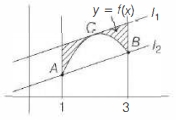
The following figure shows the graph of a continuous function $y=f(x)$ on the interval $[1,3]$. The points $A, B, C$ have coordinates $(1,1),(3,2),(2,3)$ respectively, and the lines $l_1$ and $l_2$ are parallel, with $l_1$ being tangent to the curve at $C$. If the area under the graph of $y=f(x)$ from $x=1$ to $x=3$ is $4$ sq units, then the area of the shaded region is
Let $f(x) = x^3$ be a function with domain $\{0, 1, 2, 3\}$. Then domain of $f^{-1}$ is:
If $\frac{{{d^2}y}}{{d{x^2}}} = 0,$ then
Let $R$ be a relation over the set $N × N$ and it is defined by $(a,\,b)R(c,\,d) \Rightarrow a + d = b + c.$ Then $R$ is
If $\theta$ is an acute angle and the vector $(\sin\theta)\hat{\text{i}}+(\cos\theta)\hat{\text{j}}$ is perpendicular to the vector $\hat{\text{i}}-\sqrt{3}\hat{\text{j}},$
If $\quad A=\left[\begin{array}{cc}\cos \theta & \text { isin } \theta \\ \operatorname{isin} \theta & \cos \theta\end{array}\right], \left(\theta=\frac{\pi}{24}\right)$ and $A^{5}=\left[\begin{array}{ll}a & b \\ c & d\end{array}\right],$ where $i=\sqrt{-1},$ then which one of the following is not true?
The direction cosines l, m and n of two lines are connected by the relations l + m + n = 0, l m = 0, then the angles between them is: