MCQ
If $\text{A}_{\text{r}}=\begin{vmatrix}1&\text{r}&2^{\text{r}}\\2&\text{n}&\text{n}^{2}\\\text{n}&\frac{\text{n}(\text{n}+1)}{2}&2^{\text{n}+1} \end{vmatrix},$ then the value of $\sum\limits_{\text{r}=1}^\text{n}\text{A}_\text{r}$ is:
  • A
    $n$
  • B
    $2n$
  • $-2n^3$
  • D
    $n^2$

Answer

Correct option: C.
$-2n^3$
$\text{A}_\text{r}=\begin{vmatrix}1&\text{r}&2^{\text{r}}\\2&\text{n}&\text{n}^{2}\\\text{n}&\frac{\text{n}(\text{n}+1)}{2}&2^{\text{n}+1} \end{vmatrix}$
$\Rightarrow\sum\limits_{\text{r}=1}^\text{n}\text{A}_\text{r}=\begin{vmatrix}\sum\limits_{\text{r}=1}^\text{n}1&\sum\limits_{\text{r}=1}^\text{n}\text{r}&\sum\limits_{\text{r}=1}^\text{n}2\text{r}\\\sum\limits_{\text{r}=1}^\text{n}2&\text{n}&\text{n}^{2}\\\text{n}&\frac{\text{n}(\text{n}+1)}{2}&2^{\text{n}+1} \end{vmatrix}$
As $\sum\limits_{\text{r}=1}^\text{r}1=1+1+1\ ......+1(n$ times$)=\text{n}$
$\Rightarrow\sum\limits_{\text{r}=1}^\text{r}\text{r}=1+2+3+\ .....+\text{n}=\frac{\text{n}(\text{n}+1)}{2}$
Let $\text{S}=\sum\limits_{\text{r}=1}^\text{r}2^\text{r}=2+2^2+2^3=\ .....+2^{\text{n}}$
$\Rightarrow2\text{S}=2^2+3^2=\ ....+2^{\text{n}}+2^{\text{n}+1}$
$\Rightarrow2\text{S}-\text{S}$
$\Rightarrow\text{S}=\sum\limits_{\text{r}=1}^\text{n}2^{\text{r}}=2^{\text{n+1}}-2$
$\Rightarrow\sum\limits_{\text{r}=1}^\text{n}\text{A}_\text{r}=\begin{vmatrix}\text{n}&\frac{\text{n}(\text{n}+1)}{2}&2^{\text{n}+1}-2\\2\text{n}&\text{n}&\text{n}^{2}\\\text{n}&\frac{\text{n}(\text{n}+1)}{2}&2^{\text{n}+1} \end{vmatrix}$
$[$Applying $R_1 \rightarrow R_1 - R_2]$
$\Rightarrow\sum\limits_{\text{r}=1}^\text{n}\text{A}_\text{r}=\begin{vmatrix}\text{n}-\text{n}&\frac{\text{n}(\text{n}+1)}{2}-\frac{\text{n}(\text{n}+1)}{2}&2^{\text{n}+1}-2-2^{\text{n}+1}\\2\text{n}&\text{n}&\text{n}^{2}\\\text{n}&\frac{\text{n}(\text{n}+1)}{2}&2^{\text{n}+1} \end{vmatrix}$
$=\begin{vmatrix}0&0&-2\\2\text{n}&\text{n}&\text{n}^{2}\\\text{n}&\frac{\text{n}(\text{n}+1)}{2}&2^{\text{n}+1} \end{vmatrix}$
$=-2\times\begin{vmatrix}2\text{n}&\text{n}\\\text{n}&\frac{\text{n}(\text{n}+1)}{2}\end{vmatrix}$
$=-2\big[\text{n}^{3}+\text{n}^2-\text{n}^2\big]$
$=-2\text{n}^3$

Need a full question paper?

Generate a complete, print-ready paper with questions like this in minutes — across 16+ boards, with answer keys.

Start Generating Free

Similar questions

Let $\alpha$ and $\beta$ be real numbers. Consider a $3 \times 3$ matrix $A$ such that $A ^2=3 A +\alpha I$. If $A ^4=21 A +\beta I$, then
Two adjacent sides of a parallelogram $\mathrm{ABCD}$ are given by $\overrightarrow{A B}=2 \hat{i}+10 \hat{j}+11 \hat{k}$ and $\overrightarrow{A D}=-\hat{i}+2 \hat{j}+2 \hat{k}$. The side $\mathrm{AD}$ is rotated by an acute angle $\alpha$ in the plane of the parallelogram so that $\mathrm{AD}$ becomes $\mathrm{AD}^{\prime}$. If $\mathrm{AD}^{\prime}$ makes a right angle with the side $\mathrm{AB}$, then the cosine of the angle $\alpha$ is given by
If $\smallint \frac{{5\tan x}}{{\tan x - 2\;}}dx$$ = x + aln\left| {\sin x - 2\cos x} \right| + k$ then $a $ is equal to
Choose the correct answers from the given four options:
The function $\text{f(x)}=\frac{4-\text{x}^2}{4\text{x}-\text{x}^3}$ is:
If $S$ is the circumcentre, $G$ the centroid, $O$ the orthocentre of a triangle $ABC$, then $\overrightarrow {SA} + \overrightarrow {SB} + \overrightarrow {SC} = $
Choose the correct answer in the following. Area bounded by the curve $y=x^3$, the x-axis and the ordinates $x = –2$ and $x = 1$ is:
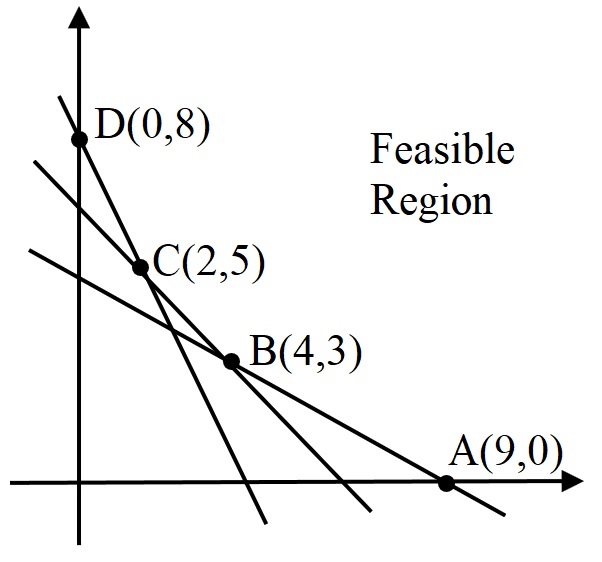
The feasible region for an $\text{LPP}$ is shown shaded in the following figure. Minimum of $Z = 4x + 3y$ occurs at the point.
If $\tan^{-1}(\cot\theta)=2\theta,$ then $\theta=$
What is the value of $\int_{0}^{\frac{\pi}{2}}\frac{\sin\text{x}-\cos\text{x}}{1+\sin\text{x}\cos\text{x}}\text{dx}?$
A wholesale dealer wants to starts the business with $Rs.\, 2,40,000$. The cost price of a quintal wheat is $Rs.\,  2000$ and the cost price of a quintal rice is $Rs.\, 3000$. He has the space capacity for $200$ quintals grain. The profit from the sale of one quintal wheat is $Rs.\, 125$ and that from one quintal rice is $Rs.\,  200$. If he has $x$ quintal rice and $y$ quintal wheat then the objective function for the maximum profit is $....$