Question
If $\text{cosec}\theta=2,$ show that $\Big(\cot\theta+\frac{\sin\theta}{1+\cos\theta}\Big)=2.$
Answer

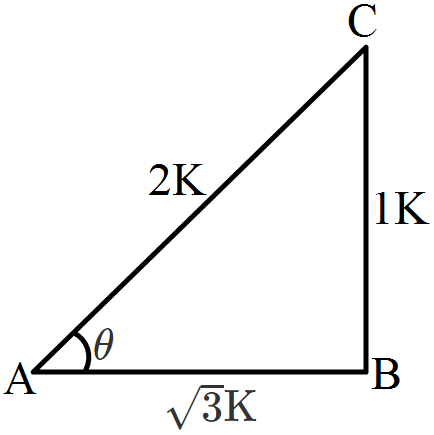
Given: $\text{cosec}\theta=\frac{\text{AC}}{\text{BC}}=\frac21$ Let $BC = 1k$ and $AC = 2k$ 
Where k is positive Let us draw a
$\triangle\text{ABC}$ in which $\angle\text{B}=90^\circ$ and $\angle\text{A}=\theta$


By Pythagoras theorem, we have
$(AC)^2 = (AB)^2 + (BC)^{2}$
$ \Rightarrow (AB)^2 = (AC)^2 - (BC)^2$​​​​​​​
$=\Big[(2\text{k})^2-(1\text{k})^2\Big]=\big(4\text{k}^2-1\text{k}^2\big)=3\text{k}^2$
$\Rightarrow(\text{AB})=\sqrt{3}\text{k}$
$\sin\theta=\frac{\text{BC}}{\text{AC}}=\frac{1\text{k}}{2\text{k}}=\frac{1}{2}$
$\cos\theta=\frac{\text{AB}}{\text{AC}}=\frac{\sqrt{3}\text{k}}{2\text{k}}=\frac{\sqrt{3}}{2}$
$\cot\theta=\frac{\cos\theta}{\sin\theta}=\Big(\frac{\sqrt{3}}{2}\times\frac21\Big)=\sqrt{3}$
$\Rightarrow\Big[\cot\theta+\frac{\sin\theta}{1+\cos\theta}\Big]\Bigg[\sqrt{3}+\frac{\frac12}{1+\frac{\sqrt{3}}{2}}\Bigg]$
$=\Big(\sqrt{3}+\frac{1}{2+\sqrt{3}}\Big)=\Big(\frac{2\sqrt{3}+3+1}{2+\sqrt{3}}\Big)$
$=\Big(\frac{2\sqrt{3}+4}{2+\sqrt{3}}\Big)=2\Big(\frac{\sqrt{3}+2}{2+\sqrt{3}}\Big)=2$
Hence, $\Big[\cot\theta+\frac{\sin\theta}{1+\cos\theta}\Big]=2$

Need a full question paper?

Generate a complete, print-ready paper with questions like this in minutes — across 16+ boards, with answer keys.
Start Generating Free

Similar questions

Find the distances between the following points.
(i) A(a, 0), B(0, a)
(ii) P(-6, -3), Q(-1, 9)
(iii) R(-3a, a), S(a, -2a)

Solve the following quadratic equation:$\text{x}^2-\big(1+\sqrt2\big)\text{x}+\sqrt2=0$
A lending library has a fixed charge for the first three days and additional charge for each day thereafter. Saritha paid Rs. 27 for a book kept for seven days, while Susy paid Rs. 21 for the book she kept for five days. Find the fixed charge and the charge for each extra day.
The following are the roots of $3x^2 + 2x - 1 = 0$?
$-\frac{1}{2}$
A two digit number is to be formed from the digits 2, 3, 5 without repetition of the digits. Complete the following activity to find the probability that the number so formed is an odd number.
Activity :
Let S be the sample space.
$\therefore S=\{23,25,32,$ ⬜, $52,53\} $
$\therefore n(S)=$ ⬜
Event A : The number so formed is an odd number.
$\therefore A=\{23,25, $ ⬜, $53\} $
$\therefore n(A)=4 $
$\therefore P(A)=\frac{⬜}{n(S)} ...... ..(\text {Formula}) $
$\therefore P(A)=\frac{⬜}{6} $
$\therefore P(A)=\frac{⬜}{3} .$
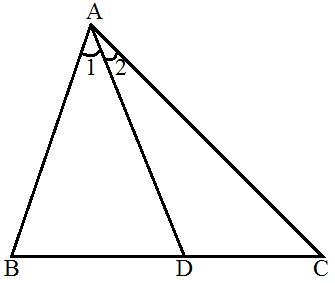
In $\triangle\text{ABC}$ (Fig.), if $\angle1=\angle2,$ prove that $\frac{\text{AB}}{\text{AC}}=\frac{\text{BD}}{\text{DC}}.$
Find the quadratic polynomial, sum of whose zeros is $0$ and their product is $-1$. Hence, find the zeros of the polynomial.
Complete the following table by writing suitable numbers and words.
Sr No.FVShare is atMV
$(1)$Rs. 100Par
$(2)$Premium Rs. 500Rs. 575
$(3)$Rs. 10Rs. 5
Solve the following simultaneous equation graphically.
3x – y – 2 = 0; 2x + y = 8
Evaluate the following:
If A and B are acute angle such that $\tan\text{A}=\frac13,\tan\text{B}=\frac12$ and $\tan(\text{A}+\text{B})=\frac{\tan\text{A}+\tan\text{B}}{1-\tan\text{A}\tan\text{B}},$ show that $\text{A}+\text{B}=45^\circ.$