Question
If $\text{m}=(\cos\theta-\sin\theta)$ and $\text{n}=(\cos\theta+\sin\theta),$ then show that $\sqrt{\frac{\text{m}}{\text{n}}}+\sqrt{\frac{\text{n}}{\text{m}}}=\frac{2}{\sqrt{1-\tan^2\theta}}.$

Answer

$\text{LHS}=\sqrt{\frac{\text{m}}{\text{n}}}+\sqrt{\frac{\text{n}}{\text{m}}}$$=\sqrt{\frac{\text{m}}{\text{n}}}+\sqrt{\frac{\text{n}}{\text{m}}}$
$=\frac{\text{m}+\text{n}}{\sqrt{\text{mn}}}$
$=\frac{(\cos\theta-\sin\theta)+(\cos\theta+\sin\theta)}{\sqrt{(\cos\theta-\sin\theta)(\cos\theta+\sin\theta)}}$
$=\frac{2\cos\theta}{\sqrt{\cos^2\theta-\sin^2\theta}}$
$=\frac{\big(\frac{2\cos\theta}{\cos\theta}\big)}{\bigg(\frac{\sqrt{cos^2\theta-\sin^2\theta}}{\cos\theta}\bigg)}$
$=\frac{2}{\sqrt{\frac{\cos^2\theta}{\cos^2\theta}-\frac{\sin^2\theta}{\cos^2\theta}}}$
$=\frac{2}{1-\tan^2\theta}$
$=\text{RHS}$

Need a full question paper?

Generate a complete, print-ready paper with questions like this in minutes — across 16+ boards, with answer keys.

Start Generating Free

Similar questions

Solve the following quadratic equation:
$\Big(\frac{\text{x}}{\text{x}}+1\Big)^2-5\Big(\frac{\text{x}}{\text{x}+1}\Big)+6=0,$ $\text{x}\neq-1$
Show graphically that each of the following given systems of equations has infinitely many solutions:
2x + y = 6, 6x + 3y = 18
Find the median of the following data by making a 'less than ogive'.
Marks
0-10
10-20
20-30
30-40
40-50
50-60
60-70
70-80
80-90
90-100
Number of students
5
3
4
3
3
4
7
9
7
8
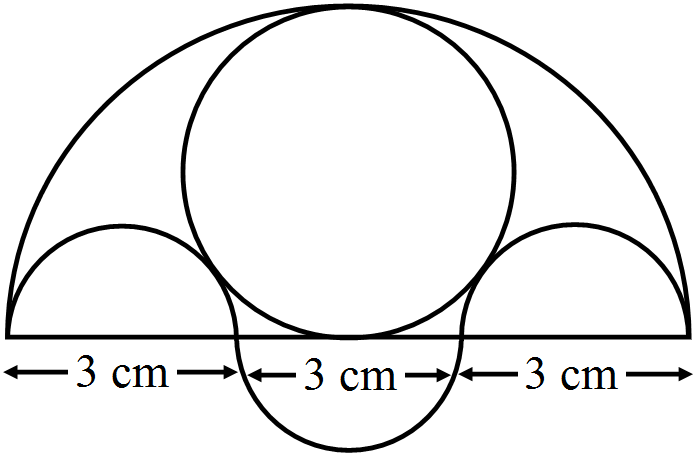
Three semicircles each of diameter 3cm, a circle of diameter 4.5,cm and a semicircle of radius 4.5cm are drawn in the given figure. Find the area of the shaded region. $\Big[\text{Use }\pi=\frac{22}{7}\Big]$
Solve for x and y:
$\frac{5}{\text{x}}-\frac{3}{\text{y}}=1,$
$\frac{3}{\text{2x}}+\frac{2}{\text{3y}}=\text{5}$ $(\text{x}\neq0,\ \text{y}\neq0).$
The production yield per hectare of wheat of some farms of a village are given in the following table:
Production yield (in kg/ha)
40-45
45-50
50-55
55-60
60-65
65-70
70-75
75-80
80-85
Number of farms
1
9
15
18
40
26
16
14
10
Draw a less than type ogive and a more than type ogive for this data.
Solve the following systems of equations by using the method of cross multiplication:
$\text{7x}-\text{2y}=3,$
$\text{11x}-\frac{3}{2}\text{y}=8$
Prove that $\big(2\sqrt3-1\big)$ is an irrational number.
If $(2\sin\theta+3\cos\theta)=2,$ and $(3\sin\theta-2\cos\theta)=\pm3.$
The $12^{th}$​​​​​​​ term of an AP is $-13$ and the sum of its first four terms is $24$. Find the sum of its first 10 terms.