Question
If $\text{x}=3+\sqrt8,$ find the value of $\text{x}^2+\frac{1}{\text{x}^2}.$

Answer

We know that $\text{x}^2+\frac{1}{\text{x}^2}=\Big(\text{x}+\frac{1}{\text{x}^2}\Big)^2-2.$ we have to find the value of $\text{x}^2+\frac{1}{\text{x}^2}.$ As $\text{x}=3+\sqrt8$ therefore,$\frac{1}{\text{x}}=\frac{1}{3+\sqrt8}$
We know that rationalization factor for $3+\sqrt8$ is $3-\sqrt8.$ We will multiply numerator and denominator of the given expression $\frac{1}{3+\sqrt8}$ by $3-\sqrt8,$ to get.$\frac{1}{\text{x}}=\frac{1}{3+\sqrt8}\times\frac{3-\sqrt8}{3-\sqrt8}$
$=\frac{3-\sqrt8}{(3)^2-\big(\sqrt8\big)^2}$
$=\frac{3-\sqrt8}{9-8}$
$=3-\sqrt8$
Putting the value of x and $\frac{1}{\text{x}},$ we get$\text{x}^2+\frac{1}{\text{x}^2}=\big(3+\sqrt8+3-\sqrt8\big)^2-2$
$=(6)^2-2$
$=36-2$
$=34$
Hence the given expression is simplified to 34.

Need a full question paper?

Generate a complete, print-ready paper with questions like this in minutes — across 16+ boards, with answer keys.
Start Generating Free

Similar questions

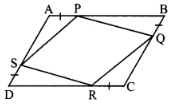
In the adjoining figure, if points P, Q, R, S are on the sides of parallelogram such that AP = BQ = CR = DS, then prove that □PQRS is a parallelogram.

Image
Given: □ABCD is a parallelogram.
AP = BQ = CR = DS
To prove: □PQRS is a parallelogram.

If $a+b=10$ and $a b=16$, find the value of $a^2-a b+b^2$ and $a^2+a b+b^2$.
Prove that in a quadrilateral the sum of all the sides is geater than the sum of its diagonals.
A village having a population of 4000 requires 150 liters of water per head per day. It has a tank measuring $20 m \times$ $15 m \times 6 m$. For how many days will the water of this tank last?
The following table gives the route length (in thousand kilometres) of the Indian Railways in some of the years:
Year 1960-61 1970-71 1980-81 1990-91 2000-2001
Route lenght (in thousand Km) 56 60 61 74 98
Represent the above data with the help of a bar graph.
Simplify:
$(2x + p - c)^2 - (2x - p + c)^2$
Find the values of a and b if:$\frac{7+3\sqrt{5}}{3+\sqrt{5}}-\frac{7-3\sqrt{5}}{3-\sqrt{5}}=\text{a}+\text{b}\sqrt{5}$
If $\text{a}^2-\frac{1}{\text{a}^2}=102,$ find the value of $\text{a}-\frac{1}{\text{a}}.$
If $\text{x}-\frac{1}{\text{x}}=3+2\sqrt2,$ find the value of $\text{x}^3-\frac{1}{\text{x}^3}.$
The following cumulative frequency distribution table shows the daily electricity consumption (in KW) of 40 factories in an industrial state.
Consumption (in KW)
No. of factories
Below 240
1
Below 270
4
Below 300
8
Below 330
24
Below 360
33
Below 390
38
Below 420
40
  1. Represent this as a frequency distribution table.
  2. Prepare a cumulative frequency table.