MCQ
If $\text{x}=\text{a}\cos^3\theta,\text{y}=\text{a}\sin^3,$ then $\sqrt{1+\Big(\frac{\text{dy}}{\text{dx}}\Big)^2}=$
  • A
    $\tan^2\theta$
  • B
    $\sec^2\theta$
  • C
    $\sec^2\theta$
  • $|\sec\theta|$

Answer

Correct option: D.
$|\sec\theta|$
We have, $\text{x}=\text{a}\cos^2\theta$
$\Rightarrow\frac{\text{dx}}{\text{d}\theta}=\text{a}\frac{\text{d}}{\text{d}\theta}(\cos^2\theta)$
$\Rightarrow\frac{\text{dx}}{\text{d}\theta}=3\text{a}\cos^2\theta\frac{\text{d}}{\text{d}\theta}(\cos\theta)$
$\Rightarrow\frac{\text{dx}}{\text{d}\theta}=-3\text{a}\cos^2\theta\sin\theta\ .....(\text{i})$
And,
$\text{y}=\text{a}\sin^3\theta$
$\Rightarrow\frac{\text{dx}}{\text{d}\theta}=\text{a}\frac{\text{d}}{\text{d}\theta}(\sin^3\theta)$
$\Rightarrow\frac{\text{dx}}{\text{d}\theta}=3\text{a}\sin^2\theta\frac{\text{d}}{\text{d}\theta}(\sin\theta)$
$\Rightarrow\frac{\text{dx}}{\text{d}\theta}=3\text{a}\sin^2\theta\cos\theta\ .....(\text{ii})$
Dividing $(ii)$ by $(i),$ we get,
$\frac{\frac{\text{dy}}{\text{d}\theta}}{\frac{\text{dx}}{\text{d}\theta}}=\frac{3\text{a}\sin^2\theta\cos\theta}{-3\text{a}\cos^2\theta\sin\theta}$
$\Rightarrow\frac{\text{dy}}{\text{dx}}=\frac{\sin\theta}{-\cos\theta}$
$\Rightarrow\frac{\text{dy}}{\text{dx}}=-\tan\theta$
Now, $\sqrt{1+\Big(\frac{\text{dy}}{\text{dx}}\Big)^2}=\sqrt{1+\tan^2\theta}$
$=\sqrt{\sec^2\theta}=|\sec\theta|$

Need a full question paper?

Generate a complete, print-ready paper with questions like this in minutes — across 16+ boards, with answer keys.

Start Generating Free

Similar questions

A cube of ice melts without changing shape at the uniform rate of $4 \,\,cm^3/min$. The rate of change of the surface area of the cube, in $cm^2/min$, when the volume of the cube is $125\,\, cm^3$, is
Find the minimum value of $f(x)=2 x^3-24 x+107$ in the interval $[1,3]$.
The number of relations $R$ from an $m$-element set $A$ to an $n$-element set $B$ satisfying the condition$\left(a, b_1\right) \in R,\left(a, b_2\right) \in R \Rightarrow b_1=b_2$ for $a \in A, b_1, b_2 \in B$ is
If $f(x) = \left\{ \begin{array}{l}{2^{1/x}},{\rm{for\,\,}}\,x \ne 0\\\,\,\,\,\,\,\,3,{\rm{for\,\,}}\,x = {\rm{0}}\end{array} \right.$, then
Let $M$ and $N$ be two $3 \times 3$ non-singular skew-symmetric matrices such that $M N=N M$. If $P^T$ denotes the transpose of $P$, then $M^2 N^2\left(M^T N\right)^{-1}\left(M N^{-1}\right)^T$ is equal to

$(A)$ $M^2$ $(B)$ $-N^2$ $(C)$ $-M^2$ $(D)$ $M N$
The integral $\int \frac{\sec ^2 x}{(\sec x+\tan x)^{9 / 2}} d x$ equals (for some arbitrary constant $K$ )
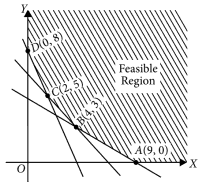
Feasible region for an L.P.P. is shown shaded in the following figure. Minimum of $Z=4 x+3 y$ occurs at the point
Image
Let $A =\left[\begin{array}{cc}1 & -1 \\ 2 & \alpha\end{array}\right]$ and $B =\left[\begin{array}{ll}\beta & 1 \\ 1 & 0\end{array}\right], \alpha, \beta \in R$. Let $\alpha_{1}$ be the value of $\alpha$ which satisfies $( A + B )^{2}= A ^{2}+\left[\begin{array}{ll}2 & 2 \\ 2 & 2\end{array}\right]$ and $\alpha_{2}$ be the value of $\alpha$ which satisfies $( A + B )^{2}= B ^{2}$. Then $\left|\alpha_{1}-\alpha_{2}\right|$ is equal to.
The equation $2\cos^{-1}\text{x}+\sin^{-1}\text{x}=\frac{11\pi}{6}$ has:
$\int {\frac{{{x^2}\, + \,2}}{{{x^4}\, + \,4}}} \,\,dx$ is equal to