Question
If $\text{x}=\text{a}(\theta-\sin\theta),\text{y}=\text{a}(1+\cos\theta)$ find $\frac{\text{d}^2\text{y}}{\text{dx}^2}$
Answer

$\text{x} =\text{a} (\theta -\sin\theta)\dots\text{ eq. } 1$
$\text{y}=\text{a}(1+\cos\theta)\dots\text{ eq. 2}$
To find: $\frac{\text{d}^2\text{y}}{\text{dx}^2}$
As, $\frac{\text{d}^2\text{y}}{\text{dx}^2}=\frac{\text{d}}{\text{dx}}\Big(\frac{\text{dy}}{\text{dx}}\Big)$
So, lets first find $\frac{\text{dy}}{\text{dx}}$ using parametric form and differentiate it again.
$\frac{\text{dx}\text{}}{\text{d}\theta}=\frac{\text{d}}{\text{d}\theta}\text{a}(\theta-\sin\theta)=\text{a}(1-\cos\theta)\dots\ \text{eq. 3}$
Similarly,
$\frac{\text{dy}}{\text{d}\theta}=\frac{\text{d}}{\text{d}\theta}\text{a}(1+\cos\theta)=-\text{a}\sin\theta\dots\text{ eq. }4$
$\Big[\because\frac{\text{d}}{\text{dx}}\cos\text{x}=-\sin\text{x},\frac{\text{d}}{\text{dx}}\sin\text{x}=\cos\text{x}\Big]$
$\therefore\frac{\text{dy}}{\text{dx}}=\frac{\frac{\text{dy}}{\text{d}\theta}}{\frac{\text{dx}}{\text{d}\theta}}=\frac{-\text{a}\sin\theta}{\text{a}(1-\cos\theta)}=\frac{-\sin\theta}{(1-\cos\theta)}\dots\ \text{eq. }5$
Differentiating again w.r.t. x:
$\frac{\text{d}}{\text{dx}}\Big(\frac{\text{dy}}{\text{dx}}\Big)=-\frac{\text{d}}{\text{dx}}\Big(\frac{\sin\theta}{1-\cos\theta}\Big)$
Using product rule and chain rule of differentiation together:
$\frac{\text{d}^2\text{y}}{\text{dx}^2}=\Big\{-\frac{1}{1-\cos\theta}\frac{\text{d}}{\text{d}\theta}\sin\theta-\sin\theta\frac{\text{d}}{\text{d}\theta}\frac{1}{(1-\cos\theta)}\Big\}\frac{\text{d}\theta}{\text{dx}}$
Apply chain rule to determine $\frac{\text{d}}{\text{d}\theta}\frac{1}{(1-\cos\theta)}$
$\frac{\text{d}^2\text{y}}{\text{dx}}=\Big\{\frac{-\cos\theta}{1-\cos\theta}+\frac{\sin^2\theta}{(1-\cos\theta)^2}\Big\}\frac{1}{\text{a}(1-\cos\theta)}$ [using eq.3]
$\frac{\text{d}^2\text{y}}{\text{dx}^2}=\bigg\{\frac{-\cos\theta(1-\cos\theta)+\sin^2\theta}{(1-\cos\theta)^2}\bigg\}\frac{1}{\text{a}(1-\cos\theta)}$
$\frac{\text{d}^2\text{y}}{\text{dx}^2}=\bigg\{\frac{-\cos\theta+\cos^2\theta+\sin^2\theta}{(1-\cos\theta)^2}\bigg\}\frac{1}{\text{a}(1-\cos\theta)}$
$\frac{\text{d}^2\text{y}}{\text{dx}^2}=\Big\{\frac{1-\cos\theta}{(1-\cos\theta)^2}\Big\}\frac{1}{\text{a}(1-\cos\theta)}[\because\cos^2\theta+\sin^2\theta=1]$
$\frac{\text{d}^2\text{y}}{\text{dx}^2}=\frac{1}{\text{a(1}-\cos\theta)^2}$
$\frac{\text{d}^2\text{y}}{\text{dx}^2}=\frac{1}{\text{a}\Big(2\sin^2\frac{\theta}{2}\Big)^2}\big[\because-\cos\theta=2\sin^2\frac{\theta}{2}\big]$
$\therefore\frac{\text{d}^2\text{y}}{\text{dx}^2}=\frac{1}{\text{4a}}\text{cosec}^4\frac{\theta}{2}$

Need a full question paper?

Generate a complete, print-ready paper with questions like this in minutes — across 16+ boards, with answer keys.

Start Generating Free

Similar questions

Five defective mangoes are acciedently mixed with 15 good ones. Four mangoes are drawn at random from this lot. Find the probability distribution of the number of defective mangoes.
Evaluate the following intregals:
$\int\frac{1}{\text{x}\log\text{x}(2+\log\text{x})}\text{ dx}$
Find the values of x and y if the vectors $\vec{\text{a}}=3\hat{\text{i}}+\text{x}\hat{\text{j}}-\hat{\text{k}}$ and $\vec{\text{b}}=2\hat{\text{i}}+\hat{\text{j}}+\text{y}\hat{\text{k}}$ are mutually perpendicular vectors of equal magnitude.
$\int\frac{1}{\text{x}^{\frac{1}{3}}\big(\text{x}^{\frac{1}{3}}-1\big)}\text{dx}$
A company is making two products A and B. The cost of producing one unit of products A and B are Rs 60 and Rs 80 respectively. As per the agreement, the company has to supply at least 200 units of product B to its regular customers. One unit of product A requires one machine hour whereas product B has machine hours available abundantly within the company. Total machine hours available for product A are 400 hours. One unit of each product A and B requires one labour hour each and total of 500 labour hours are available. The company wants to minimize the cost of production by satisfying the given requirements. Formulate the problem as a LPP.
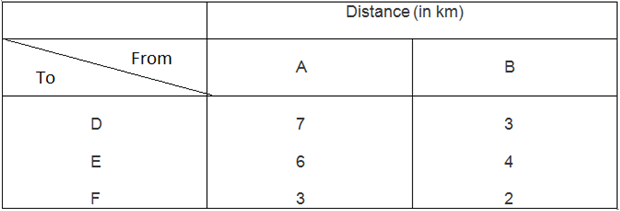
An oil company has two depots, A and B, with capacities of 7000 litres and 4000 litres respectively. The company is to supply oil to three petrol pumps, D, E, F whose requirements are 4500, 3000 and 3500 litres respectively. The distance (in km) between the depots and petrol pumps is given in the following table:

Assuming that the transportation cost per km is Rs. 1.00 per litre, how should the delivery be scheduled in order that the transportation cost is minimum?
Evaluate the following integrals:$\int\limits^{\frac{\pi}{2}}_0\frac{1}{1+\cot\text{x}}\text{ dx}$
Discuss the continuity of the f(x) at the indicated points f(x) = |x - 1| + |x + 1| at x = -1, 1.
Find the maximum and minimum of the following functions:
f(x) = x log x
A firm manufactures two products $A$ and $B$. Each product is processed on two machines $M_1$ and $M_2$. Product $A$ requires $4$ minutes of processing time on $M_1$ and $8$ min . on $M_2$; product $B$ requires 4 minutes on $M_1$ and 4 min . on $M _2$. The machine $M _1$ is available for not more than $8$ hrs $20$ min . while machine $M _2$ is available for 10 hrs. during any working day. The products $A$ and $B$ are sold at a profit of Rs. $3$ and Rs. $4$ respectively.
Formulate the problem as a linear programming problem and find how many products of each type should be produced by the firm each day in order to get maximum profit.