MCQ
If $\text{x}+\text{iy}=(1+\text{i})(1+2\text{i})(1+3\text{i}),$ then $\text{x}^2+\text{y}^2=$
  • A
    0
  • B
    1
  • 100
  • D
    none of these

Answer

Correct option: C.
100
$\therefore\text{x}+\text{iy}=(1+\text{i})(1+2\text{i})(1+3\text{i})$
Taking modulus on both the sides:
$|\text{x}+\text{iy}|=|(1+\text{i})(1+2\text{i})(1+3\text{i})|$
$\Rightarrow|\text{x}+\text{iy}|=|(1+\text{i})|\times|(1+2\text{i})|\times|(1+3\text{i})|$
$\Rightarrow\sqrt{\text{x}^2+\text{y}^2}=\sqrt{1^2+1^2}\sqrt{1^2+2^2}\sqrt{1^2+3^2}$
$\Rightarrow\sqrt{\text{x}^2+\text{y}^2}=\sqrt{2}\sqrt{5}\sqrt{10}$
$\Rightarrow\sqrt{\text{x}^2+\text{y}^2}=\sqrt{100}$
Squaring both the sides,
$\Rightarrow\text{x}^2+\text{y}^2=100$

Need a full question paper?

Generate a complete, print-ready paper with questions like this in minutes — across 16+ boards, with answer keys.

Start Generating Free

Similar questions

Let S be a non-empty subset of R. Consider the following statement: p : There is a rational number x such that x > 0. Which of the following statements is the negation of the statement P?
Number of values of $x$ satisfying $2sin^22x = 2cos^28x + cos10x$ in $x  \in \left[ { - \frac{\pi }{4},\frac{\pi }{4}} \right]$ is-
The points of intersection of the curves whose parametric equations are $x = {t^2} + 1,\;y = 2t$ and $x = 2s,\;y = \frac{2}{s}$ is given by
If  $\alpha  , \beta $ are two real numbers satisfying $\alpha^2 + \beta^2$ = $ 5$ and $3(\alpha^5 +  \beta^5) = 11$$(\alpha^3 + \beta^3)$, then $\alpha  \beta$ is 
If variable point $(x, y)$ satisfies the equation $x^2 + y^2 -8x -6y + 9 = 0$ , then range of $\frac{y}{x}$ is
If $z = x + iy,\,{z^{1/3}} = a - ib$ and $\frac{x}{a} - \frac{y}{b} = k\,({a^2} - {b^2})$ then value of $k$ equals
If $\alpha ,\,\beta ,\,\gamma ,\,\delta $ are the smallest positive angles in ascending order of magnitude which have their sines equal to the positive quantity $k$ , then the value of $4\sin \frac{\alpha }{2} + 3\sin \frac{\beta }{2} + 2\sin \frac{\gamma }{2} + \sin \frac{\delta }{2}$ is equal to 
Let $n \geq 3$. A list of numbers $x_1, x, \ldots, x_n$ has mean $\mu$ and standard deviation $\sigma$. A new list of numbers $y_1, y_2, \ldots, y_n$ is made as follows $y_1=\frac{x_1+x_2}{2}, y_2=\frac{x_1+x_2}{2}$ and $y_j=x_j$ for $j=3,4, \ldots, n$.

The mean and the standard deviation of the new list are $\hat{\mu}$ and $\hat{\sigma}$. Then, which of the following is necessarily true?

Among the statements:

$(S1):$ $2023^{2022}-1999^{2022}$ is divisible by $8.$

$(S2)$ : $13(13)^{ n }-11 n -13$ is divisible by $144$ for infinitely many $n \in N$.
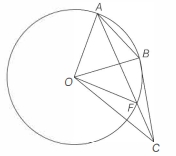
On the circle with center $O$, points $A$ and $B$ are such that $O A=A B$. A point $C$ is located on the tangent at $B$ to the circle such that $A$ and $C$ are on the opposite sides of the line $O B$ and $A B=B C$. The line segment $A C$ intersects the circle again at $F$. Then, the ratio $\angle B O F: \angle B O C$ is equal to