MCQ
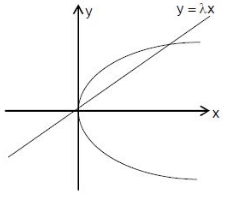
If the area (in sq. units) bounded by the parabola $y^2 =4\lambda x$ and the line $y = \lambda x$, $\lambda  > 0$, is $\frac{1}{9}$, then $\lambda $ is equal to
  • A
    $48$
  • B
    $4\sqrt 3$
  • C
    $2\sqrt 6$
  • $24$

Answer

Correct option: D.
$24$
d
$y^{2}=4 \lambda x$ and $y=\lambda x$

$\lambda^{2} x^{2}=4 \lambda x$

$x=0$ and $x=\frac{4}{\lambda}$

Area $ = \int\limits_0^{4\lambda } {(\sqrt {4\lambda x}  - \lambda x)} dx = \frac{1}{9}$

$ \Rightarrow 2\sqrt \lambda   \times \left( {\frac{{{x^{3/2}}}}{{3/2}}} \right)_0^{4/\lambda } - \lambda \left( {\frac{{{x^2}}}{2}} \right)_0^{4/\lambda } = \frac{1}{9}$

$\frac{4}{3} \sqrt{\lambda} \times\left(2^{2}\right)^{3 / 4} \frac{x}{\lambda^{3 / 2}}-\frac{x}{2} \times \frac{16}{\lambda}=\frac{1}{9}$

$\Rightarrow \frac{32}{3 \lambda}-\frac{8}{\lambda}=\frac{1}{9}$

$\Rightarrow \frac{8}{3 \lambda}=\frac{1}{9}$

$\lambda=24$
Need a full question paper?

Generate a complete, print-ready paper with questions like this in minutes — across 16+ boards, with answer keys.

Start Generating Free

Similar questions

Which of the following relations is correct
lf $x + \left| y \right| = 2y,$ then $y$ as a function of $x,$ at $x = 0$ is
Let $\mathrm{ABC}$ be an equilateral triangle. A new triangle is formed by joining the middle points of all sides of the triangle $\mathrm{ABC}$ and the same process is repeated infinitely many times. If $\mathrm{P}$ is the sum of perimeters and $Q$ is be the sum of areas of all the triangles formed in this process, then:
The roots of the equation ${x^2} + ax + b = 0$are $p$, and $q$, then the equation whose roots are ${p^2}q$ and $p{q^2}$ will be
$\int_{}^{} {{{\cos }^5}x\;dx = } $
Let $f:[0, \infty) \rightarrow \mathbb{R}$ be differentiable function such that $f(\mathrm{x})=1-2 \mathrm{x}+\int_{0}^{x} e^{x-t} f(t) \mathrm{dt}$ for all $\mathrm{x} \in[0, \infty)$. Then the area of the region bounded by $\mathrm{y}=f(\mathrm{x})$ and the coordinate axes is
The locus of the centre of the circle $\frac{1}{2} (x^2 + y^2) + x \cos \theta + y \sin \theta -4 = 0$ is :-
Consider the following two statements:
Statement $I$ : For any two non $-$ zero complex numbers $z_1, z_2$ 
$\left(\left|z_1\right|+\left|z_2\right|\right)\left|\frac{z_1}{\left|z_1\right|}+\frac{z_2}{\left|z_2\right|}\right| \leq 2\left(\left|z_1\right|+\left|z_2\right|\right)$ 
Statement $II$ : If $x, y, z$ are three distinct complex numbers and $a, b, c$ are three positive real numbers
such that $\frac{a}{|y-z|}=\frac{b}{|z-x|}=\frac{c}{|x-y|}$ then
$\frac{a^2}{y-z}+\frac{b^2}{z-x}+\frac{c^2}{x-y}=1$
Let the solution curve $y = y ( x )$ of the differential equation $\quad \frac{d y}{d x}-\frac{3 x^5 \tan ^{-1}\left(x^3\right)}{\left(1+x^6\right)^{\frac{3}{2}}} y=2 x$ $\exp \frac{x^3-\tan ^{-1} x^3}{\sqrt{(1+x)^6}}$ pass through the origin. Then $y (1)$ is equal to:
A circle is inscribed in an equilateral triangle of side $a$, the area of any square inscribed in the circle is