Question
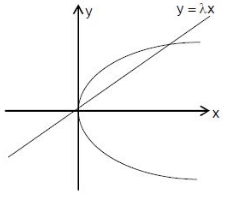
If the area (in sq. units) bounded by the parabola $y^2 =4\lambda x$ and the line $y = \lambda x$, $\lambda  > 0$, is $\frac{1}{9}$, then $\lambda $ is equal to

Answer

d
$y^{2}=4 \lambda x$ and $y=\lambda x$

$\lambda^{2} x^{2}=4 \lambda x$

$x=0$ and $x=\frac{4}{\lambda}$

Area $ = \int\limits_0^{4\lambda } {(\sqrt {4\lambda x}  - \lambda x)} dx = \frac{1}{9}$

$ \Rightarrow 2\sqrt \lambda   \times \left( {\frac{{{x^{3/2}}}}{{3/2}}} \right)_0^{4/\lambda } - \lambda \left( {\frac{{{x^2}}}{2}} \right)_0^{4/\lambda } = \frac{1}{9}$

$\frac{4}{3} \sqrt{\lambda} \times\left(2^{2}\right)^{3 / 4} \frac{x}{\lambda^{3 / 2}}-\frac{x}{2} \times \frac{16}{\lambda}=\frac{1}{9}$

$\Rightarrow \frac{32}{3 \lambda}-\frac{8}{\lambda}=\frac{1}{9}$

$\Rightarrow \frac{8}{3 \lambda}=\frac{1}{9}$

$\lambda=24$
Need a full question paper?

Generate a complete, print-ready paper with questions like this in minutes — across 16+ boards, with answer keys.

Start Generating Free

Similar questions

The number of different words can be formed from the letters of the word $'SUCCESS'$ in which the two $C$ are together but no two $S$ are together are :-
Consider the function $f: \mathbb{R} \rightarrow \mathbb{R}$ defined by

$f(x)=\frac{2 x}{\sqrt{1+9 x^2}}$. If the composition of $f, \underbrace{(f \circ f \circ f \circ \ldots \circ f)}_{10 \text { times }}(x)=\frac{2^{10} x}{\sqrt{1+9 \alpha x^2}}$, then the value of $\sqrt{3 \alpha+1}$ is equal to....................

If sum of $n$ terms of an $A.P.$ is $3{n^2} + 5n$ and ${T_m} = 164$ then $m = $
If $A$ lies in the third quadrant and $3\ tanA - 4 = 0$ , then find the value of $5\ sin\ 2A + 3\  sinA + 4\  cosA$
Let the functions $:(-1,1) \rightarrow R$ and $g:(-1,1) \rightarrow(-1,1)$ be defined by $f(x)=|2 x-1|+|2 x+1|$ and $g(x)=x-[x]$,

where $[x]$ denotes the greatest integer less than or equal to $x$. Let $f \circ:(-1,1) \rightarrow R$ be the composite function defined by $(f \circ g)(x)=f(g(x))$. Suppose $c$ is the number of points in the interval $(-1,1)$ at which $f \circ g$ is NOT continuous, and suppose $d$ is the number of points in the interval $(-1,1)$ at which $f \circ g$ is $NOT$ differentiable. Then the value of $c+d$ is. . . . .

Let A = {1, 2, 3, 4} and R = {(1, 2), (2, 3), (1, 4)} be a relation on A. Let S be the equivalence relation on A such that $R \subset S$ and the number of elements in S is n. Then, the minimum value of n is _________
Let the function $f: R \rightarrow R$ be defined by $f(x)=\frac{\sin x}{ e ^{\pi x}} \frac{\left(x^{2023}+2024 x+2025\right)}{\left(x^2-x+3\right)}+\frac{2}{e^{\pi x}} \frac{\left(x^{2023}+2024 x+2025\right)}{\left(x^2-x+3\right)}.$ Then the number of solutions of $f( x )=0$ in $R$ is
The number of positive integers $n$ in the set $\{1,2,3$, $\ldots \ldots . ., 100\}$ for which the number $\frac{1^2+2^2+3^2+\ldots .+n^2}{1+2+3+\ldots+n}$ is an integer is
$\sum {{1 \over {1 + {x^{a - b}} + {x^{a - c}}}} = } $
The average marks of boys in class is $52$ and that of girls is $42.$ The average marks ofboys and girls combined is $50.$ The percentage of boys in the class is