Question
If the bar magnet in exercise 5.13 is turned around by 180°, where will the new null points be located?

Answer

The rnaqnettc field on the axis of the rnagnet at a distance d1 = 14 cm, can be written as:
$\text{B}_1=\frac{\mu_02\text{M}}{4\pi(\text{d}_1)^3}=\text{H}\ \dots(1)$
Where,
M = Magnetic moment
$\mu_0$ = Permeability of free space
H = Horizontal component of the magnetic field at d1
If the bar magnet is turned through 180°, then the neutral point will lie on the equatorial line.
Hence, the magnetic field at a distance dz, on the equatorial line of the magnet can be Written as:
$\text{B}_2=\frac{\mu_0\text{M}}{4\pi(\text{d}_2)^3}=\text{H}\ \dots(2)$
Equating equations (1) and (2), we get:
$\frac{2}{(\text{d}_1)^3}=\frac{1}{(\text{d}_2)^3}$
$\Big(\frac{\text{d}_2}{\text{d}_1}\Big)^3=\frac{1}{2}$
$\therefore\ \text{d}_2=\text{d}_1\times\Big(\frac{1}{2}\Big)^{\frac{1}{3}}$
= 14 × 0794 = 11.1 cm
The new null points will be located 11.1 cm on the normal bisector.

Need a full question paper?

Generate a complete, print-ready paper with questions like this in minutes — across 16+ boards, with answer keys.

Start Generating Free

Similar questions

A vector $\overrightarrow{\text{A}}$ makes an angle of 20° and $\overrightarrow{\text{B}}$ makes an angle of 110° with the X-axis. The magnitudes of these vectors are 3 m and 4 m respectively. Find the resultant.
Draw a propagation diagram of a linearly polarized electromagnetic wave and write any two characteristics of electromagnetic wave.Magnitude of magnetic field associated with an electromagnetic wave in vacuum is $B_0=50 \times 10^{-8} T$. Write the magnitude of electric field associated with the wave in volt/meter
Suppose the glass of the previous problem is covered by a jar and the air inside the jar is completely pumped out.
  1. What will be the answers to the problem?
  2. Show that the answers do not change if a glass of different shape is used provided the height, the bottom area and the volume are unchanged.
What is the magnitude of magnetic force per unit length on a wire carrying a current of 8 A and making an angle of 30º with the direction of a uniform magnetic field of 0.15 T?
A proton has spin and magnetic moment just like an electron. Why then its effect is neglected in magnetism of materials?
The equation of a wave travelling on a string is:

$\text{y}=(0.10\text{mm})\sin\big[(31.4\text{m}^{-1})\text{x}+(314\text{s}^{-1})\text{t}\big].$
  1. In which direction does the wave travel?
  2. Find the wave speed, the wavelength and the frequency of the wave.
  3. What is the maximum displacement and the maximum speed of a portion of the string?
The decay constant of 238U is 4.9 × 10⁻¹⁸ S-1.
  1. What is the average-life of 238U?
  2. What is the half-life of 238U?
  3. By what factor does the activity of a 238U sample decrease in 9 × 10⁹ years?
  1. Draw a graph showing variation of photocurrent with anode potential for a particular intensity of incident radiation. Mark saturation current and stopping potential.
  2. By how much would the stopping potential for a given photosensitive surface go up if the frequency of the incidentradiations were to be increased from $4\times10^{15}\text{ }\text{Hz}\text{ }\text{to}8\text{ }\times10^{15}\text{ }\text{Hz}$?
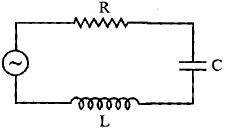
The figure shows a series LCR circuit with L = 5.0 H, C = 80 $\mu$F, R = 40 W connected to a variable frequency 240V source. Calculate

  1. The angular frequency of the source which drives the circuit at resonance.
  2. The current at the resonating frequency.
  3. The rms potential drop across the capacitor at resonance.
The specification on a heater coil is 250V, 500W. Calculate the resistance of the coil. What will be the resistance of a coil of 1000W to operate at the same voltage?