MCQ
If the current is passed into the solution of an electrolyte
- ✓Anions move towards anode, cations towards cathode
- BAnions and cations both move towards anode
- CAnions move towards cathode, cations towards anode
- DNo movement of ions takes place
Generate a complete, print-ready paper with questions like this in minutes — across 16+ boards, with answer keys.
$(i)\,\,KIO_3$ $(ii)\,\,KI$
$(iii)\,\,I_2$ $(iv)\,\, HI$
Given : $K _{ sp } Cu ( OH )_2=1 \times 10^{-20}$
$\operatorname{Take} \frac{2.303 RT }{ F }=0.059 \,V$
The reduction potential at $pH =14$ for the above couple is $(-) x \times 10^{-2}\,V$. The value of $x$ is $........$.
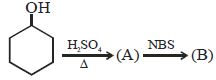
$(i) \,\,\begin{array}{*{20}{c}}
{C{H_3}\,\,\,\,\,\,\,\,\,\,\,} \\
{|\,\,\,\,\,\,\,\,\,\,\,\,\,\,\,\,\,\,} \\
{C{H_3} - C - CH - C{H_3}} \\
{\,\,\,\,\,|} \\
{\,\,\,\,\,\,\,\,\,\,\,\,OH}
\end{array}\,\xrightarrow{{{H^ + }/heat}}\,\,\mathop A\limits_{[Major\,product]} \, + \,\mathop B\limits_{[Minor\,product]} $
$(ii)\,\, A\xrightarrow[{in\,\,absence\,\,\,of\,peroxide}]{{HBr,\,dark}}\,\,\mathop C\limits_{[Major\,product]} \, + \,\mathop D\limits_{[Minor\,product]} $
the major products $(A)$ and $(C)$ are respectively