MCQ
If the dimensions of a physical quantity are given by $M^aL^bT^c$ ,then physical quantity will be 
  • A
    velocity if  $a=1,b=0,c=-1$
  • B
    acceleration if  $a=1,b=1,c=-2$
  • C
    force if $a=0,b=-1,c=-2$
  • pressure if $a=1,b=-1,c=-2$

Answer

Correct option: D.
pressure if $a=1,b=-1,c=-2$
d
Pressure, $p = \frac{{force}}{{area}} = \frac{{mass\, \times \,acceleration}}{{area}}$
$\therefore \,\left[ P \right] = \frac{{{M^1}L{T^{ - 2}}}}{{{L^2}}} = \left[ {{M^1}{L^{ - 1}}{T^{ - 2}}} \right] = \,{M^a}{L^b}{T^c}$
$\therefore \,a = 1,\,b =  - 1,\,c =  - 2.$

Need a full question paper?

Generate a complete, print-ready paper with questions like this in minutes — across 16+ boards, with answer keys.
Start Generating Free

Similar questions

An air bubble of radius $r$ in water is at depth $h$ below the water surface at same instant. If $P$ is atmospheric pressure and $d$ and $T$ are the density and surface tension of water respectively. The pressure inside the bubble will be
A very long (length $L$ ) cylindrical galaxy is made of uniformly distributed mass and has radius $R(R < < L).$ A star outside the galaxy is orbiting the galaxy in a plane perpendicular to the galaxy and passing through its centre. If the time period of star is $T$ and its distance from the galaxy's axis is $r,$ then
Consider a point $P$ on the circumference of a disc rolling along a horizontal surface. If $R$ is the radius of the disc, the distance through which $P$ moves in one full rotation of the disc  is:
Which one of the following physical quantities is not a fundamental quantity?
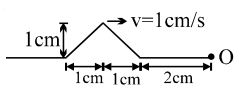
A wave pulse on a string has the dimension shown in figure. The waves speed is $v = 1 \,\,cm/s$. If point $O$ is a free end. The shape of wave at time $t = 3 \,\,s$ is :
A beam of metal supported at the two ends is loaded at the centre. The depression at the centre is proportional to
An ideal gas having molar specific heat capacity at constant volume is $\frac32\text{R}$ the molar specific heat capacities at constant pressure is:
An object at rest at the origin begins to move in the $+x$-direction with a uniform acceleration of $1 \,m / s ^2$ for $4 \,s$ and then it continues moving with a uniform velocity of $4 \,m / s$ in the same direction.The $x-t$ graph for object's motion will be
Consider the situation of the previous problem. The directions of the magnetic field due to the dipole are opposite at:
  1. P1 and P2
  2. Q1 and Q2
  3. P1 and Q1
  4. P2 and Q2
Bernoulli’s principle is based on the law of conservation of