If the direction of the initial velocity of the charged particle is neither along nor perpendicular to that of the magnetic field, then the orbit will be
Easy
Download our app for free and get started
The perpendicular component will be responsible for circular motion and parallel component will take it along the magnetic field. Considering both the phenomena, the resultant motion will be helical.

Download our appand get started for free
Experience the future of education. Simply download our apps or reach out to us for more information. Let's shape the future of learning together!No signup needed.*
Similar Questions
- 1A circular loop is kept in that vertical plane which contains the north-south direction. It carries a current that is towards south at the topmost point. Let $A$ be a point on axis of the circle to the east of it and $B$ a point on this axis to the west of it. The magnetic field due to the loop :-View Solution
- 2The magnetic field existing in a region is given by $\vec B\, = {B_0}\,\left[ {1 + \frac{x}{l}} \right]\,\hat k\,A$ square loop of edge $l$ and carrying current $I_0$ , is placed with its edges parallel to the $x-y$ axis . Find the magnitude of the net magnetic force experienced by the loopView Solution
- 3The radius of a circular current carrying coil is $R$. At what distance from the centre of the coil on its axis, the intensity of magnetic field will be $\frac{1}{2 \sqrt{2}}$ times that at the centre?View Solution
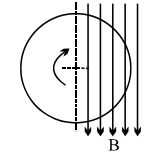
- 4A thin non conducting disc of radius $R$ is rotating clockwise (see figure) with an angular velocity $w$ about its central axis, which is perpendicular to its plane. Both its surfaces carry $+ve$ charges of uniform surface density. Half the disc is in a region of a uniform, unidirectional magnetic field $B$ parallel to the plane of the disc, as shown. Then,View Solution
- 5$\alpha$ particle is revolving in radius $r$ with frequency $f$ then find value of magnetic dipole moment.View Solution
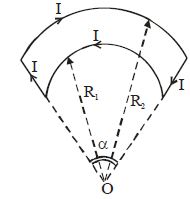
- 6The magnetic induction at the centre $O$ of the current carrying bent wire shown in the adjoining figure isView Solution
- 7Two straight parallel wires, both carrying $10$ $ampere$ in the same direction attract each other with a force of $1 \times {10^{ - 3}}\,N$. If both currents are doubled, the force of attraction will beView Solution
- 8A galvanometer of resistance $25\,\Omega $ gives full scale deflection for a current of $10$ milliampere, is to be changed into a voltmeter of range $100\, V$ by connecting a resistance of $‘R’$ in series with galvanometer. The value of resistance $R$ in $\Omega $ isView Solution
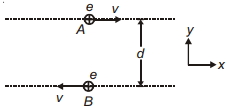
- 9Two protons $A$ and $B$ move parallel to the $x$-axis in opposite directions with equal speeds $v$. At the instant shown, the ratio of magnetic force and electric force acting on the proton $A$ is ( $c=$ speed of light in vacuum)View Solution
- 10A coil having $100$ turns, area of $5 \times 10^{-3} \mathrm{~m}^2$, carrying current of $1 \mathrm{~mA}$ is placed in uniform magnetic field of $0.20 \mathrm{~T}$ such a way that plane of coil is perpendicular to the magnetic field. The work done in turning the coil through $90^{\circ}$ is . . . . . . $\mu \mathrm{J}$.View Solution