Question
If the equation $\left(1+m^2\right) x^2+2 m c x+\left(c^2-a^2\right)=0$ has equal roots, prove that $c^2=a^2\left(1+m^2\right)$.

Answer

The given equation $\left(1+m^2\right) x^2+2 m c x+\left(c^2-a^2\right)=0$, has equal roots,
Then prove that $c^2=a^2\left(1+m^2\right)$
Here, $a=\left(1+m^2\right), b=2 m c$ and $c=\left(c^2-a^2\right)$
As we know that $D=b^2-4 a c$
Putting the value of $a=\left(1+m^2\right), b=2 m c$ and $c=\left(c^2-a^2\right)$
$\Rightarrow D = b^2 - 4ac$
$\Rightarrow D = {2mc}^2 - 4 \times (1 + m^2) \times (c^2 - a^2)$
$\Rightarrow D = 4(m^2c^2) - 4(c^2 - a^2 + m^2c^2 - m^2a^2)$
$\Rightarrow D = 4m^2c^2 - 4c^2 + 4a^2 - 4m^2c^2 + 4m^2a^2$
$\Rightarrow D = 4a^2 + 4m^2a^2 - 4c^2$​​​​​​​
The given equation will have real roots, if D = 0
$\Rightarrow 4a^2 + 4m^2a^2 - 4c^2 = 0$
$\Rightarrow 4a^2 + 4m^2a^2 = 4c^2$
$\Rightarrow 4a^2(1 + m^2) = 4c^2$
$Hence, c^2 = a^2(1 + m^2)$

Need a full question paper?

Generate a complete, print-ready paper with questions like this in minutes — across 16+ boards, with answer keys.
Start Generating Free

Similar questions

Prove the following trigonometric identities.
Given that: $(1+\cos\alpha)(1+\cos\beta)(1+\cos\gamma)=(1-\cos\alpha)(1-\cos\alpha)(1-\cos\beta)(1-\cos\gamma)$
Show that one of the values of each member of this equality is $\sin\alpha\sin\beta\sin\gamma.$
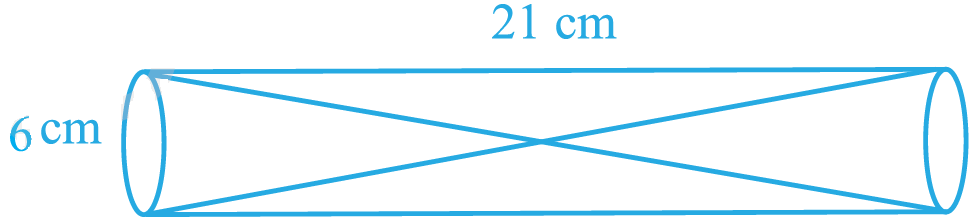
Two solid cones A and B are placed in a cylinderical tube as shown in the Fig. The ratio of their capacities are 2 : 1. Find the heights and capacities of cones. Also, find the volume of the remaining portion of the cylinder.
Solve the following systems of equations:
$\frac{1}{2\text{x}}+\frac{1}{3\text{y}}=2$
$\frac{1}{3\text{x}}+\frac{1}{2\text{y}}=\frac{13}{6}$
If $\alpha$ and $\beta$ are the zeros of the polynomial $f(x)=x^2-6 x+k$, find the value of k for $\alpha^2+\beta^2=40$.
From a point on the ground 40m away from the foot of a tower, the angle ofclevation of the top of the t wer is 30°. The angle of elevation of the top of a water tank (on the top of the tower) is 45°. Find:
  1. The height of the tower.
  2. The depth of the tank.
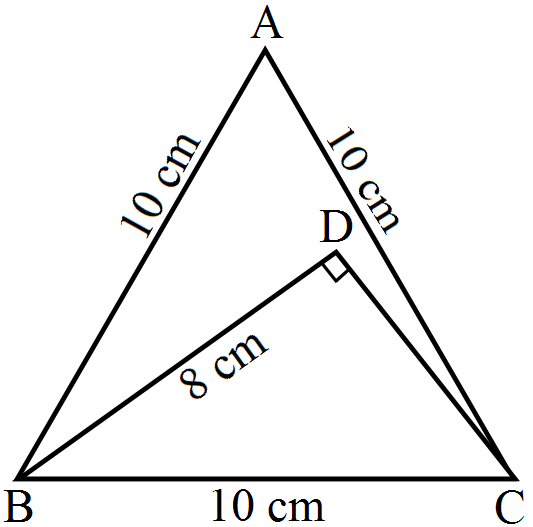
In the given figure, $\triangle\text{ABC}$ is an equilateral triangle the length of whose side is equal to 10cm, and $\triangle\text{DBC}$ is right-angled at D and BD = 8cm. Find the area of the shaded region. $\big[\text{Take}\sqrt{3}=1.41\big]$
Solve the following systems of equations graphically:
x + y = 4
2x - 3y = 3
A train takes $2$ hours less for a journey of $300 \ km$ if its speed is increased by $5 \ km/hr$ from its usual speed. Find the usual speed of the train.
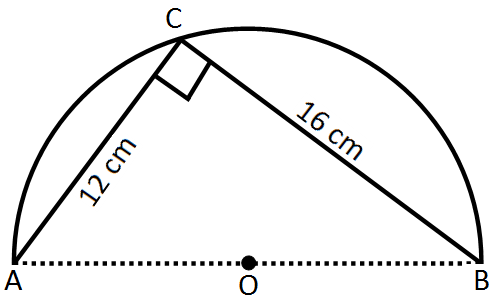
In the following figure, O is the centre of a circular arc and AOB is a straight line. Find the perimeter and the area of the shaded region correct to one decimal place. $\big(\text{Take }\pi=3.142\big)$
The first and last terms of an AP are $a$ and I respectively. Show that the sum of the $n ^{\text {th }}$ term from the beginning and the $n ^{\text {th }}$ term from the end is $(a+1)$.