MCQ
If the frequency of an object in uniform circular motion is doubled, its acceleration becomes
  • A
    Two times
  • Four times
  • C
    Half
  • D
    One fourth

Answer

Correct option: B.
Four times
b
(b)

Acceleration $\propto f ^2$

So when frequency is double acceleration is $4$ times.

Need a full question paper?

Generate a complete, print-ready paper with questions like this in minutes — across 16+ boards, with answer keys.
Start Generating Free

Similar questions

An object is moving on a circular track of radius $450\, m$. At some instant, the object is moving at $30\, m/s$ and gaining speed at a uniform rate of $2 m/s^2$. Its acceleration at this instant is nearly  .......... $m/s^2$
Two bodies are projected with the same velocity. If one is projected at an angle of ${30^o}$ and the other at an angle of ${60^o}$ to the horizontal, the ratio of the maximum heights reached is
Both earth and moon are subject to the gravitational force of the sun. As observed from the sun, the orbit of the moon.
A body of mass $2.9\, kg$ is suspended from a string of length $2.5\, m$ and is at rest. A bullet of mass $100\, g$ , strikes the block horizontally with velocity $150 \,ms^{-1}$  and sticks to it. What is the maximum angle made by the string with the vertical after  the impact ? .............. $^o$ $(g = 10\, m/s^2) $
A particle starts from rest and performing circular motion of constant radius with speed given by $v = \alpha \sqrt x$ where $\alpha$ is a constant and $x$ is the distance covered. The correct graph of magnitude of its tangential acceleration $(a_t)$ and centripetal acceleration $(a_c)$ versus $t$ will be:
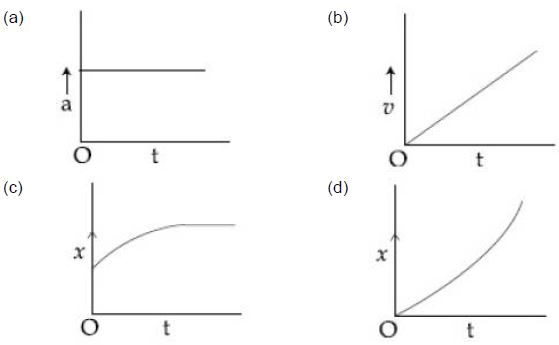
A particle starts from origin $O$ from rest and moves with a uniform acceleration along the positive $x -$ axis. Identify all figures that correctly represent the motion qualitatively. ($a =$ acceleration, $v =$ velocity, $x =$ displacement, $t =$ time)
A ball is thrown from a point with a speed ${v_o}$ at an angle of projection $\theta $. From the same point and at the same instant a person starts running with a constant speed ${v_o}/2$ to catch the ball. Will the person be able to catch the ball? If yes, what should be the angle of projection
$Assertion$ : If collision occurs between two elastic bodies their kinetic energy decreases during the time of collision.

$Reason$ : During collision intermolecular space decreases and hence elastic potential energy increases.
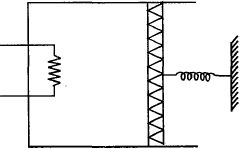
An ideal monoatomic gas is confined in a cylinder by a spring loaded piston of cross section $8.0\times10^{-3}\, m^2$ . Initially the gas is at $300\, K$ and occupies a volume of $2.4\times10^{-3}\, m^3$ and the spring is in its relaxed state as shown in figure. The gas is heated by a small heater until the piston moves out slowly by $0.1\, m$. The force constant of the spring is $8000\, N/m$ and the atmospheric pressure is $1.0\times10^5\, N/m^2$ . The cylinder and the piston are thermally insulated. The piston and the spring are massless and there is no friction between the piston and the cylinder. The final temperature of the gas will be: (Neglect the heat loss through the lead wires of the heater . The heat capacity of the heater coil is also negligible)
The height $h$ of the liquid column in a capillary tube on Earth is $h$. On the Moon, where the acceleration due to gravity of earth is $1/6.$ This height is :