MCQ
If the gravitational force between two objects were proportional to $\frac{1}{R}$ (and not as $1/{R^2})$ where $R$ is separation between them, then a particle in circular orbit under such a force would have its orbital speed $v$ proportional to
  • A
    $\frac{1}{{R^2}}$
  • ${R^0}$
  • C
    ${R^1}$
  • D
    $\frac{1}{R}$

Answer

Correct option: B.
${R^0}$
b
(b)Gravitational force provides the required centripetal force for orbiting the satellite
$\frac{{m{v^2}}}{R} = \frac{K}{R}$    because $\left( {F \propto \frac{1}{R}} \right)$
 $v \propto R^\circ $

Need a full question paper?

Generate a complete, print-ready paper with questions like this in minutes — across 16+ boards, with answer keys.

Start Generating Free

Similar questions

The rate of cooling due to conduction, convection, and radiation combined, is proportional to the difference in temperature, for:
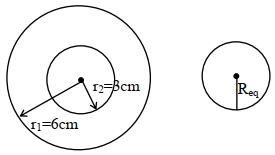
A soap bubble of radius $3\, {cm}$ is formed inside the another soap bubble of radius $6\, {cm}$. The radius of an equivalent soap bubble which has the same excess pressure as inside the smaller bubble with respect to the atmospheric pressure is .......... ${cm}$ 
A thin uniform rod of length $l$ and mass $m$ is swinging freely about a horizontal axis passing through its end. Its maximum angular speed is $\omega $. Its centre of mass rises to a maximum height of
According to kinetic theory of gases the $\text{r.m.s}.$ velocity of the gas molecules is directly proportional to:
A particle is projected from ground with velocity $u$ at angle $\theta$ from horizontal. Match the following two columns.
Column $I$ Column $II$
$(A)$ Average velocity between initial and final points $(p)$ $u \sin \theta$
$(B)$ Change in velocity between initial and final points $(q)$ $u \cos \theta$
$(C)$ Change in velocity between initial and final points $(r)$ Zero
$(D)$ Average velocity between initial and highest points $(s)$ None of the above
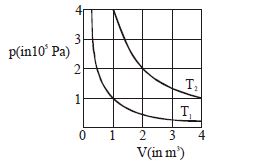
The given diagram shows isotherms for a fixed mass of an ideal gas at temperature $T_1$ and $T_2$ . What is the value of the ratio $\frac{{{\text{r}}{\text{.m}}{\text{.s}}{\text{. speed of the molecules at temperature }}{{\text{T}}_{2{\text{ }}}}}}{{{\text{r}}{\text{.m}}{\text{.s}}{\text{. speed of the molecules at temperature }}{{\text{T}}_1}}}$ ?
The angular speed of seconds needle in a mechanical watch is
The work done in which of the following processes is equal to the internal energy of the system?
Three force $F_1=10\,N , F_2=8\,N , F _3=6\,N$ are acting on a particle of mass $5\,kg$. The forces $F _2$ and $F _3$ are applied perpendicular so that particle remains at rest. If the force $F_1$ is removed, then the acceleration of the particle is $......ms^{-2}$
What is the phase difference between the displacement wave and pressure wave in sound wave?