MCQ
If the initial velocity of a projectile be doubled, keeping the angle of projection same, the maximum height reached by it will
  • A
    Remain the same
  • B
    Be doubled
  • Be quadrupled
  • D
    Be halved

Answer

Correct option: C.
Be quadrupled
c
(c) $H = \frac{{{u^2}{{\sin }^2}\theta }}{{2g}}\,$

$\therefore \,\,H \propto {u^2}.$

If initial velocity be doubled then maximum height reached by the projectile will quadrupled.

Need a full question paper?

Generate a complete, print-ready paper with questions like this in minutes — across 16+ boards, with answer keys.
Start Generating Free

Similar questions

Two sphere of radius $R_1$ and $R_2$ have densities ${\rho _1}$ and  ${\rho _2}$ and specific heat $S_1$ and $S_2$ if they are heated to the same temperature the ratio of their rates of falling temperature will be
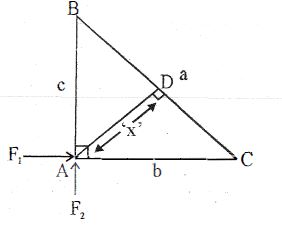
Two forces acting on point $A$ along their side and having magnitude reciprocal to length of side then resultant of these forces will be proportional to
A stone dropped from the top of a tower is found to travel $\left(\frac{5}{9}\right)$ of the height of the tower during the last second of its fall. The time of fall is ....... $s$
The average velocity of a body moving with uniform acceleration travelling a distance of $3.06\, m$ is $ 0.34 ms^{-1}$. If the change in velocity of the body is $ 0.18ms^{-1}$ during this time, its uniform acceleration is.........$ms^{-2}$
$\mathrm{N}$ moles of a polyatomic gas $(f=6)$ must be mixed with two moles of a monoatomic gas so that the mixture behaves as a diatomic gas. The value of $\mathrm{N}$ is:
The coefficient of friction between a body and the surface of an inclined plane at $45^°$ is $0.5.$ If $g = 9.8\,m/{s^2}$, the acceleration of the body downwards in $m/{s^2}$ is
Mark the correct statements:
When a horse pulls a wagon, the force that causes the horse to move forward is the force
The initial velocity of a body moving along a straight line is $7 \,m/s$. It has a uniform acceleration of $4\,m/{s^2}$. The distance covered by the body in the $5^{th}$ second of its motion is..........$m$
The relationship between pressure and the density of a gas expressed by Boyle’s law, $ P = KD$ holds true