Question
If the light moving in a straight line bends by a small but fixed angle, it may be a case of:

Answer

  1. Reflection.
  2. Refraction.
Explanation:
When the light strikes on a surface nearly parallel to it, it then bends by a small and fixed angle after reflection. Also, when the light travels from one medium to another with slight differences in their refractive indices, it bends by a small angle. Thus, the bending of light by a small but fixed angle can be the case of either reflection or refraction.

Need a full question paper?

Generate a complete, print-ready paper with questions like this in minutes — across 16+ boards, with answer keys.
Start Generating Free

Similar questions

The two elements, with same number of electrons but different mass number, are known as:
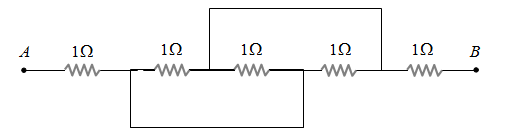
Equivalent resistance between the points $A$ and $B$ is $($in $\Omega)$
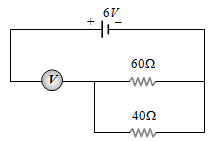
The measurement of voltmeter in the following circuit is
Which of the following statements about the Bohr model of the hydrogen atom is false(a) Acceleration of electron in n = 2 orbit is less than that in n = 1 orbit(b) Angular momentum of electron in n = 2 orbit is more than that in n = 1 orbit(c) Kinetic energy of electron in n = 2 orbit is less than that in n = 1 orbit(d) Potential energy of electron in n = 2 orbit is less than that in n = 1 orbit


A piece of semiconductor is connected in series in an electric circuit. On increasing the temperature, the current in the circuit will(a) Decrease(b) Remain unchanged(c) Increase(d) Stop flowing
       
Atomic number (Z) of a neutral atom and mass number (A) of an atom are equal to:(Here n = number of neutrons and p = number of protons):
If one of the two slits of Young's double-slit experiment is painted so that it transmits half the light intensity as the second slit, then:
An electron is travelling along the X-direction. It encounters a magnetic field in the Y-direction. Its subsequent motion will be:
A cell of internal resistance r is connected to an external resistance R. The current will be maximum in R, if:
A charged particle moves along a circle under the action of possible constant electric and magnetic fields. Which of the following are possible?