MCQ
If the liquid in a U-tube of cross-section A rises to a height $h$. Then the period of oscillatory motion of the fluid is T. Liquid in a U-tube of cross section $\frac{A}{2}$ If you fill up to the height and make it oscillate then the time period will be :
  • T
  • B
    T/2
  • C
    2T
  • D
    1/4

Answer

Correct option: A.
T
(A)

Need a full question paper?

Generate a complete, print-ready paper with questions like this in minutes — across 16+ boards, with answer keys.

Start Generating Free

Similar questions

The centre of mass of a system of particles is at the origin. It follows that:
Consider a collision between an oxygen molecule and a hydrogen molecule in a mixture of oxygen and hydrogen kept at room temperature. Which of the following are pcssible?
  1. The kinetic energies of both the molecules increase.
  2. The kinetic energies of both the molecules decrease.
  3. The Kinetic energy of the oxygen molecule increases and that of the hydrogen molecule decreases.
  4. The kinetic energy of the hydrogen molecule increases and that of the oxygen molecule decreases.
The angular frequency of motion whose equation is $4\frac{{{d^2}y}}{{d{t^2}}} + 9y = 0$ is ($y =$ displacement and $t =$ time)
In stationary wave
Two samples $A$ and $B$ of a gas initially at the same pressure and temperature are compressed from volume $ V$ to $ V/2$ ($A$ isothermally and adiabatically). The final pressure of $ A$ is
The radius of a circle is $2.12$ metre. Its area according to the rule of significant figures is ......... $m ^2$
Given that $v$ is speed, $r$ is the radius and $g$ is the acceleration due to gravity. Which of the following is dimensionless
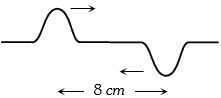
Two pulses in a stretched string whose centres are initially $8 cm$ apart are moving towards each other as shown in the figure. The speed of each pulse is $2 cm/s$. After $2$ seconds, the total energy of the pulses will be
A body $A$ moves with a uniform acceleration $a$ and zero initial velocity. Another body $B$, starts from the same point moves in the same direction with a constant velocity $v$. The two bodies meet after a time $t$. The value of $t$ is
The greatest height to which a man can throw a stone is $h$. The greatest distance to which he can throw it, will be