MCQ
If the path difference between the slits $S_1$ and $S_2$ is $\lambda$, the central fringe will have an intensity of:
  • $0$
  • B
    $a^2$
  • C
    $2a^2$
  • D
    $4a^2$

Answer

Correct option: A.
$0$

Path difference at the central fringe will be the same as the path difference at the slits i.e. $\lambda$.
Hence, the waves reaching the central fringe will be $180^\circ $ out of phase and will result in destructive interference. Hence, the intensity of the central fringe will be $0.$

Need a full question paper?

Generate a complete, print-ready paper with questions like this in minutes — across 16+ boards, with answer keys.
Start Generating Free

Similar questions

Monochromatic light of frequency $5 \times 10^{14}$ Hz travelling in vacuum enters a medium of refractive index 1.5. Its wavelength in the medium is
A thin circular ring of mass M and radius r is rotating about its axis with an angular speed $\omega.$ Two particles having mass m each are now attached at diametrically opposite points. The angular speed of the ring will become:
In a series resonant $L-C-R$ circuit, the voltage across $R$ is $100\,V$ and $R = 1\,k\Omega $ with $C = 2\,\mu F$ . The resonant frequency $\omega $ is $200\,rad\,s^{-1}$ . At resonance the voltage across $L$ is.....$V$
Coulomb’s Law is valid for $........$?
An electric bulb is made to work at 12 V dc. When this bulb is joined with an ac source, it gives normal brightness. Peak voltage of ac source is:
A charge q is placed at the centre of the line joining two equal charges Q. The system of the three charges will be in equilibrium, if q is equal to
Holes are charge carriers in
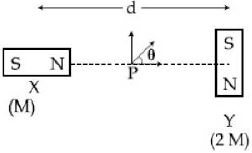
Two magnetic dipoles $X$ and $Y$ are placed at a separation $d$, with their axes perpendicular to each other. The dipole moment of $Y$ is twice that of $X$. A particle of charge $q$ is passing through their mid-point $P$, at angle $\theta  = 45^o$ with the horizontal line as shown in the figure. What would be the magnitude of force on the particle at that instant ? ($d$ is much larger than the dimensions of the dipole)
A point charge +q is placed at the centre of a cube of side L. The electric flux emerging from the cube is
In a series $LCR$ circuit, resonance occurring at $105 Hz$ . At that time, the potential difference across the $100$ resistance is $40 V$ while the potential difference across the pure inductor is $30 v$ . The inductance $L$ of the inductor is equal to.