Question
If the point $C(-1,2)$ divides internally the line segment joining the points $A(2,5)$ and $B(x, y)$ in the ratio $3: 4$, find the value of $x^2+y^2$.

Answer

It is given that the point $C(-1,2)$ divides the line segment joining the points $A(2,5)$ and $B(x, y)$ in the ratio $3: 4$ internally.
Using the section formula, we get
$(-1,2)=\left(\frac{3 \times x+4 \times 2}{3+4}, \frac{3 \times y+4 \times 5}{3+4}\right)$
$\Rightarrow(-1,2)=\left(\frac{3 x+8}{7}, \frac{3 y+20}{7}\right)$
$\Rightarrow \frac{3 x+8}{7}=-1 \text { and } \frac{3 y+20}{7}=2$
$\Rightarrow 3 x+8=-7 \text { and } 3 y+20=14$
$\Rightarrow 3 x=-15 \text { and } 3 y=-6$
$\Rightarrow x=-5 \text { and } y=-2$
$\therefore x^2+y^2=25+4=29$
Hence, the value of $x^2+y^2$ is $29$ .

Need a full question paper?

Generate a complete, print-ready paper with questions like this in minutes — across 16+ boards, with answer keys.
Start Generating Free

Similar questions

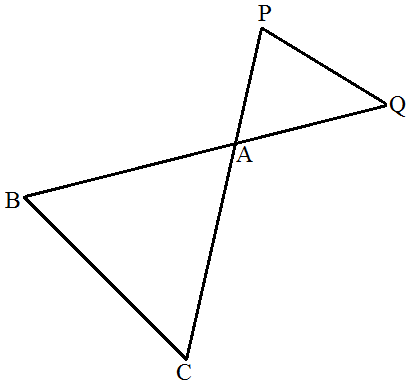
In the given figure, $\triangle\text{ACB}\sim\triangle\text{APQ}.$ If BC = 10cm, PQ = 5cm, BA = 6.5cm and AP = 2.8cm, find CA and AQ. Also, find the area$ (\triangle\text{ACB)}$ : area $ (\triangle\text{APQ)}.$
If $r_1$ and $r_2$​​​​​​​ be the radii of two solid metallic spheres and if they are melted into one solid sphere, prove that the radius of the new sphere is $(\text{r}_1^3+\text{r}_2^3).\frac{1}{3}$
Find the mean marks of the student from the following cumulative frequency distribution.
MarksBelow
10
Below
20
Below
30
Below
40
Below
50
Below
60
Below
70
Below
80
Below
90
No. of
students
5917294560707883
Given $\tan\theta=\frac{1}{\sqrt{5}},$ what is the value of $\frac{\text{cosec}^2\theta-\sec^2\theta}{\text{cosec}^2\theta+\sec^2\theta}?$
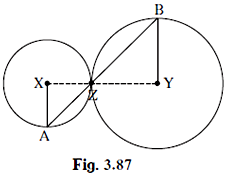
In the adjoining figure circles with centres X and Y touch each other at point Z. A secant passing through Z intersects the circles at points A and B respectively. Prove that, radius XA || radius YB. Fill in the blanks and complete the proof.

Construction: Draw segments XZ and ..YZ........ .
Proof: By theorem of touching circles, points X, Z, Y are ..concyclic........ .
$\therefore \angle XZA \cong \ldots \angle YZB \ldots \ldots \ldots$.....vertically opposite angles
Let $\angle XZA =\angle BZY = a \cdots( l )$
Now, seg XA $\cong \operatorname{seg} X Z$........ (...radius of the same circle......)
$\therefore \angle XAZ =\ldots . \angle XZA \ldots \ldots=$ a $\ldots \ldots \ldots$ (isosceles triangle theorem) (II)
similarly, seg $Y B \cong . Y Z . \ldots . \ldots \ldots .$. ........ (radius of the same circle........)
$\therefore \angle BZY =\angle Z B Y \ldots \ldots \ldots= a$ $\qquad$ (isosceles triangle theorem. $\qquad$
$\therefore$ from (I), (II), (III),
$\angle XAZ =. \angle ZBY \ldots \ldots \ldots$.
$\therefore$ radius $XA \|$ radius YB $\qquad$ (..since alternate interior angles are equal.......)
Prove the following trigonometric identities.
If $\text{x}=\text{a}\cos^3\theta,\text{y}=\text{b}\sin^3\theta,$ prove that $\Big(\frac{\text{x}}{\text{a}}\Big)^\frac{2}{3}+\Big(\frac{\text{y}}{\text{b}}\Big)^\frac{2}{3}=1.$
Split 69 in three parts such that they are in A.P. and product of two smaller parts is 483.
Evaluate the following:
$\sin^230^\circ+\sin^245^\circ+\sin^260^\circ+\sin^260^\circ+\sin^290^\circ\dots(1)$
Solve the following simultaneous equation graphically.
3x – y = 2; 2x – y = 3