Question
If the points $\mathrm{A}(h, 0), \mathrm{B}(0, \mathrm{k})$ and $\mathrm{C}(\mathrm{a}, \mathrm{b})$ lie on a line, then show that $\frac{a}{h}+\frac{b}{k}=1$.'
$\begin{array}{ll}\therefore \quad & \frac{k-0}{0-h}=\frac{b-k}{a-0} \\ \therefore \quad & a k=-h(b-k) \\ \therefore \quad & \frac{a}{h}=\frac{k-b}{k} \\ \therefore \quad & \frac{a}{h}=1-\frac{b}{k} \\ \therefore \quad & \frac{a}{h}+\frac{b}{k}=1\end{array}$
Generate a complete, print-ready paper with questions like this in minutes — across 16+ boards, with answer keys.
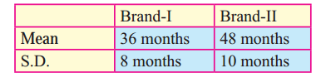
Calculate the coefficient of variation of the two brands and interpret the results.
$a_{i j}=\frac{(i-j)^2}{5-i}$
$\mathrm{f}(\mathrm{x})=\frac{x-7}{4}, \mathrm{~g}(\mathrm{x})=4 \mathrm{x}+7$