MCQ
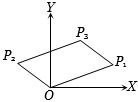
If the points ${P_1}$and ${P_2}$ represent two complex numbers ${z_1}$ and ${z_2}$, then the point ${P_3}$ represents the number
  • ${z_1} + {z_2}$
  • B
    ${z_1} - {z_2}$
  • C
    ${z_1} \times {z_2}$
  • D
    ${z_1} \div {z_2}$

Answer

Correct option: A.
${z_1} + {z_2}$
a
(a) This is a parallelogram $O{P_1}{P_2}{P_3}$. Then the mid point of ${P_1}{P_2}$ and $O{P_3}$ are the same. But midpoint of ${P_1}{P_2}$is $\left( {\frac{{{x_1} + {x_2}}}{2},\frac{{{y_1} + {y_2}}}{2}} \right)$
So that the coordinates of ${P_3}$are $\left( {{x_1} + {x_2},{y_1} + {y_2}} \right)$
Thus the point ${P_3}$ corresponds to sum of the complex number ${z_1}$ and ${z_2}$.
${\overrightarrow {OP} _3} = {\overrightarrow {OP} _1} + \overrightarrow {{P_1}{P_3}} = {\overrightarrow {OP} _1} + {\overrightarrow {OP} _2} = {z_1} + {z_2}$

Need a full question paper?

Generate a complete, print-ready paper with questions like this in minutes — across 16+ boards, with answer keys.

Start Generating Free