Question
If the potential difference applied to the tube is doubled and the separation between the filament and the target is also doubled, the cutoff wavelength:

Answer

  1. Will be halved.
Explanation:
Cut off wavelength is given by
$\lambda_{\text{min}}=\frac{\text{hc}}{\text{eV}'}$
where h = Planck's constan
c = speed of light
e = charge on an electron
V = potential difference applied to the tube
When potential difference (V) applied to the tube is doubled, cutoff wavelength
$\big({\lambda}'_\text{min}\big)$ is given by
${\lambda}'_\text{min}=\frac{\text{hc}}{\text{e}(2\text{V})}$
$\Rightarrow\lambda'_\text{min}=\frac{\lambda_\text{min}}{2}$
Cuttoff wavelength does not depend on the separation between the filament and the target.
Thus, cutoff wavelength will be halved if the the potential difference applied to the tube is doubled.

Need a full question paper?

Generate a complete, print-ready paper with questions like this in minutes — across 16+ boards, with answer keys.
Start Generating Free

Similar questions

The binding energy per nucleon of deuterium and helium atom is 1.1 MeV and 7.0 MeV. If two deuterium nuclei fuse to form helium atom, the energy released is(a) 19.2 MeV(b) 23.6 MeV(c) 26.9 MeV(d) 13.9 MeV
       
Assertion : The focal length of the mirror is $f$ and distance of the object from the focus is $u,$ the magnification of the mirror is $f / u.$
Reason : Magnification $= \frac{\text { Size of image }}{\text { Size of object }}$ 
A parallel$-$plate capacitor has plates of unequal area. The larger plate is connected to the positive terminal of the battery and the smaller plate to its negative terminal. Let $Q_+$ and $Q_-$ be the charges appearing on the positive and negative plates respectively:
Which of the following waves have a maximum frequency?
A dip circle is taken to geomagnetic equator. The needle is allowed to move in a vertical plane perpendicular to the mangetic meridian. the needle will stay in:
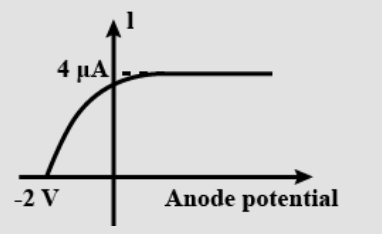
The graph shown below depicts plot of photocurrent versus anode potential for a cathode with 4 eV work function. The energy of the incident photon is:
A player with $3 m$ long iron rod runs towards east with a speed of $30 \ km/hr.$ Horizontal component of earth's magnetic field is $4\times 10^{-5} \mathrm{wb} / \mathrm{m}^2$.. If he is running with rod in horizontal and vertical positions, then the potential difference induced between the two ends of the rod in two cases will be
A free electron is placed in the path of a plane electromagnetic wave. The electron will start moving:
  1. Along the electric field.
  2. Along the magnetic field.
  3. Along the direction of propagation of the wave.
  4. In a plane containing the magnetic field and the direction of propagation.
Two lithium nuclei in a lithium vapour at room temperature do not combine to form a carbon nucleus because:
  1. A lithium nucleus is more tightly bound than a carbon nucleus.
  2. Carbon nucleus is an unstable particle.
  3. It is not energetically favourable.
  4. Coulomb repulsion does not allow the nuclei to come very close.
Which among the following has weak temperature dependence values with resistivity?