Question
If the potential difference used to accelerate electrons is tripled, by what factor does de Broglie wavelength of electrons beam change?

Answer

de Broglie wavelength of electrons accelerated through a potential difference of V volts is $\lambda=\frac{\text{h}}{\sqrt{2\text{meV}}}$
When accelerating voltage V is tripled, the de Broglie wavelength becomes $\frac{1}{\sqrt{3}}$ times.

Need a full question paper?

Generate a complete, print-ready paper with questions like this in minutes — across 16+ boards, with answer keys.
Start Generating Free

Similar questions

  1. An em wave is travelling in a medium with a velocity $\overrightarrow{\text{v}} = \text{v}\hat{\text{i}}.$ Draw a sketch showing the propagation of the em wave, indicating the direction of the oscillating electric and magnetic fields.
  2. How are the magnitudes of the electric and magnetic fields related to the velocity of the em wave?
A Rowland ring of mean radius 15 cm has 3500 turns of wire wound on a ferromagnetic core of relative permeability 800. What is the magnetic field B in the core for a magnetising current of 1.2 A?
A pivoted aluminium bar falls much more slowly through a small region containing a magnetic field than a similar bar of an insulating material. Explain.
An iron needle is attracted to the ends of a bar magnet but not to the middle region of the magnet. Is the material making up the ends of a bar magnet different from that of the middle region?
An electron gun emits $2\times10^{16}$ electrons per second. What electric current does this correspond to?
Does short-sightedness (myopia) or long-sightedness (hypermetropia) imply necessarily that the eye has partially lost its ability of accommodation? If not, what might cause these defects of vision?
Explain Inductance. Give its unit and dimensions.
A $15.0 \mu F$ capacitor is connected to a $220 V , 50 Hz$ source. Find the capacitive reactance and the current (rms and peak) in the circuit. If the frequency is doubled, what happens to the capacitive reactance and the current?
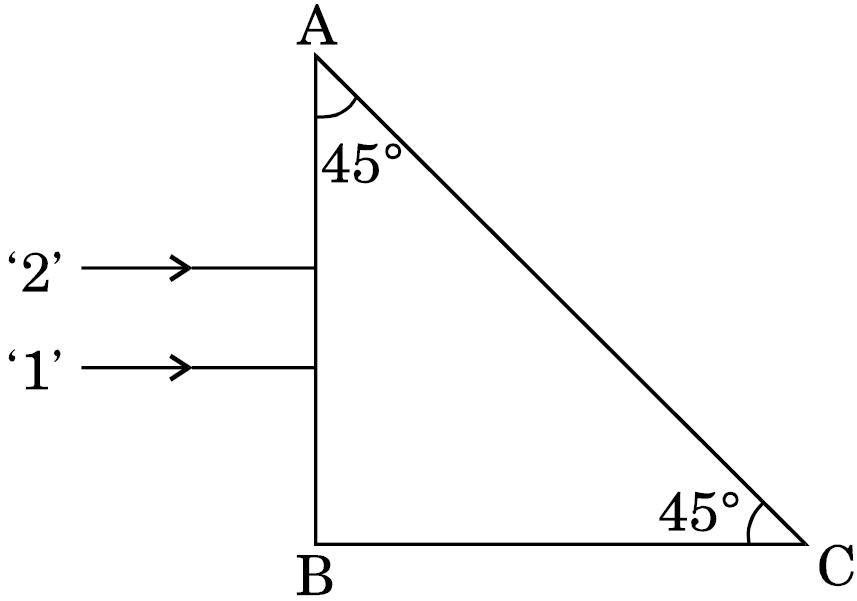
Two monochromatic rays of light are incident normally on the face AB of an isosceles right-angled prism ABC. The refractive indices of the glass prism for the two rays ‘1’ and ‘2’ are respectively 1.3 and 1.5 Trace the path of these rays after entering through the prism.
What is the resistance of an intrinsic semiconductor at 0K?