Question
If the radius of the earth decreases by 1% without changing its mass, will the acceleration due to gravity at the surface of the earth increase or decrease? If so, by what per cent?

Answer

If we consider the Earth to be a perfect sphere, then the acceleration due to gravity at its surface is given by $\text{g}=\text{G}\frac{\text{M}}{\text{R}^2}$ Here, M is the mass of Earth; R is the radius of the Earth and G is universal gravitational constant. If the radius of the earth is decreased by 1%, then the new radius becomes,$\text{R'}=\text{R}-\frac{\text{R}}{100}=\frac{99}{100}\text{R}$
$\Rightarrow\text{R'}=-0.99\text{R}$
New acceleration due to gravity will be given by,$\text{g'}=\text{G}\frac{\text{M}}{\text{R}^2}=\text{G}\frac{\text{M}}{(0.99\text{R})^2}$
$\Rightarrow\text{g'}=1.02\times\Big(\text{G}\frac{\text{M}}{\text{R}^2}\Big)=1.02\text{g}$
Hence, the value of the acceleration due to gravity increases when the radius is decreased. Percentage increase in the acceleration due to gravity is given by,$\frac{\text{g'}-\text{g}}{\text{g}}\times100$
$=\frac{0.02\text{g}}{\text{g}}\times100$
$=2\%$

Need a full question paper?

Generate a complete, print-ready paper with questions like this in minutes — across 16+ boards, with answer keys.
Start Generating Free

Similar questions

A simple pendulum with a brass has a time period T. The bob is now immersed in a non-viscous liquid and oscillated. If the density of the liquid is $\frac{1}{9}$ that of brass, find the time period of the same pendulum.
An object weighing $70kg$ is kept in a lift. Find its weight as recorded by a spring balance when the lift
  1. Moves upwards with a uniform velocity of $5ms^{-1}$,
  2. Moves upwards with a uniform acceleration of $2.2ms^{-2}$
  3. Moves downwards with a uniform acceleration of $2.8ms^{-2}$ and
  4. Falls freely under gravity.
A $20cm$ long conducting rod is set into pure translation with a uniform velocity of $10cm/s^{-1}$ perpendicular to its length. A uniform magnetic field of magnitude $0.10T$ exists in a direction perpendicular to the plane of motion.
  1. Find the average magnetic force on the free electrons of the rod.
  2. For what electric field inside the rod, the electric force on a free elctron will balance the magnetic force? How is this electric field created?
  3. Find the motional emf between the ends of the rod.
A girl riding a bicycle with a speed of $5m/ s$ towards north direction, observes rain falling vertically down. If she increases her speed to $10m/ s$, rain appears to meet her at $45°$ to the vertical. What is the speed of the rain? In what direction does rain fall as observed by a ground based observer?
(Hint: Assume north to be $\hat{\text{i}}$ direction and vertically downward to be $-\hat{\text{j}}$. Let the rain velocity $\text{v}_\text{r}$ be $\text{a}\hat{\text{i}}+\text{b}\hat{\text{j}}.$ The velocity of rain as observed by the girl is always $V_r-V_{girl}$. Draw the vector diagram/s for the information given and find a and b. You may draw all vectors in the reference frame of ground based observer)
On the basis of molecular kinetic theory of gases, derive the laws of Boyle, Charles, pressure law or Gay-Lussac, Graham's diffusion, Dalton's partial pressure, Avogadro's laws for any gas.
In an experiment to estimate the size of a molecule of oleic acid 1mL of oleic acid is dissolved in 19mL of alcohol. Then 1mL of this solution is diluted to 20mL by adding alcohol. Now 1 drop of this diluted solution is placed on water in a shallow trough. The solution spreads over the surface of water forming one molecule thick layer. Now, lycopodium powder is sprinkled evenly over the film and its diameter is measured. Knowing the volume of the drop and area of the film we can calculate the thickness of the film which will give us the size of oleic acid molecule.
Read the passage carefully and answer the following questions:
  1. Why do we dissolve oleic acid in alcohol?
  2. What is the role of lycopodium powder?
  3. What would be the volume of oleic acid in each mL of solution prepared?
  4. How will you calculate the volume of n drops of this solution of oleic acid?
  5. What will be the volume of oleic acid in one drop of this solution?
It is often said that the world is witnessing now a second industrial revolution, which will transform the society as radically as did the first. List some key contemporary areas of science and technology, which are responsible for this revolution.
  1. What is the phenomenon of capillarity? Derive an expression for the rise of liquid in a capillary tube.
  2. What will happen if the length of the capillary tube is smaller than the height to which the liquid rises? Explain briefly.
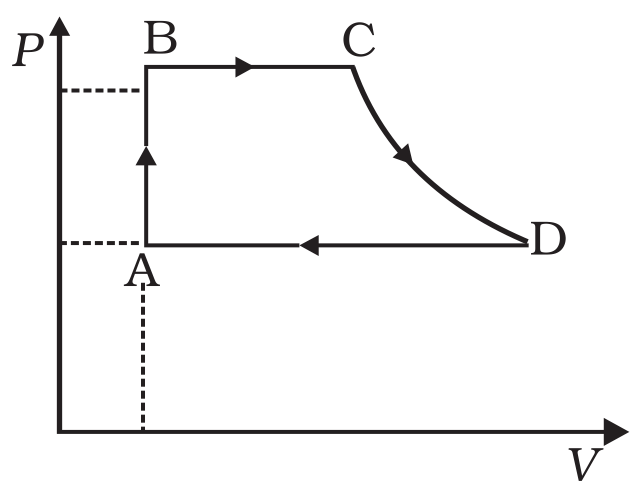
A cycle followed by an engine (made of one mole of an ideal gas in a cylinder with a piston) is shown in Fig. Find heat exchanged by the engine, with the surroundings for each section of the cycle. $(C_v = (3/2) R)$

AB : constant volume
BC : constant pressur CD : adiabati DA : constant pressure
Name the physical quantity of the dimension given below:
i. $\mathrm{ML}^{\circ} \mathrm{T}^{-3}$
ii. $\mathrm{ML}^{-1} \mathrm{~T}^{-1}$
iii. $\mathrm{M}^{-1} \mathrm{~L}^3 \mathrm{~T}^{-2}$
iv. $\mathrm{ML}^2 \mathrm{~T}^{-3}$
v. $\mathrm{ML}^0 \mathrm{~T}^{-2}$
vi. $\mathrm{T}^{-1}$