Question
If the red light is replaced by blue light illuminating the object in a microscope the resolving power of the microscope
Answer

(b) $R.P.$ $ \propto \frac{1}{\lambda } \Rightarrow \frac{{{{(R.P.)}_1}}}{{{{(R.P.)}_2}}} = \frac{{{\lambda _2}}}{{{\lambda _1}}} = \frac{5}{4}$

Need a full question paper?

Generate a complete, print-ready paper with questions like this in minutes — across 16+ boards, with answer keys.

Start Generating Free

Similar questions

The number of possible natural oscillations of air column in a pipe closed at one end of length $85 \,\,cm$ whose frequencies lie below $1250\,\, Hz$ are (Velocity of sound $= 340 \,\,m s^{-1}$)
The equation for spherical progressive wave is (where $r$ is the distance from the source) 
The vector $\vec E$ and $\vec B$ of an electromagnetic wave in vacuum are
Assume that Solar constant is $1.4 \,kW / m ^2$, radius of sun is $7 \times 10^5 \,km$ and the distance of earth from centre of sun is $1.5 \times 10^{8} \,km$. Stefan's constant is $5.67 \times 10^{-6} \,Wm ^{-2} K ^{-4}$, find the approximate temperature of sun ....... $K$
When a particle is thrown vertically upwards, its velocity at one third of its maximum height is $10 \sqrt{2}\,m / s$. The maximum height attained by it is .......... $m$
In which of the following stores maximum energy ?
For a simple pendulum the graph between $L$ and $T$ will be.
A steady current $I$ flows through a wire of radius $r$, length $L$ and resistivity $\rho$. The current produces heat in the wire. The rate of heat loss in a wire is proportional to its surface area. The steady temperature of the wire is independent of
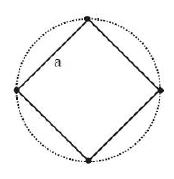
Four identical particles of mass $M$ are located at the corners of a square of side $‘a’$. What should be their speed if each of them revolves under the influence of other’s gravitational field in a circular orbit circumscribing the square?
There exists an electric field of magnitude $E$ in $x$-direction. If the work done in moving a charge of $0.2 \,C$ through a distance of $2 \,m$ along a line making an angle $60^{\circ}$ with $x$-axis is $4 \,J$, then the value of $E$ is ........ $N / C$