Question
If the separation between the slits in a Young's double slit experiment is increased, what happens to the fringe-width? If the separation is increased too much, will the fringe pattern remain detectable?

Answer

The fringe width in Young's double slit experiment depends on the separation of the slits.$\text{x}=\frac{\lambda\text{D}}{\text{d}},$
where$\lambda$ = wavelength
x = fringe width D = distance between slits and screen d = separation between slits On increasing d, fringe width decreases. If the separation is increased too much, the fringes will merge with each other and the fringe pattern won't be detectable.

Need a full question paper?

Generate a complete, print-ready paper with questions like this in minutes — across 16+ boards, with answer keys.
Start Generating Free

Similar questions


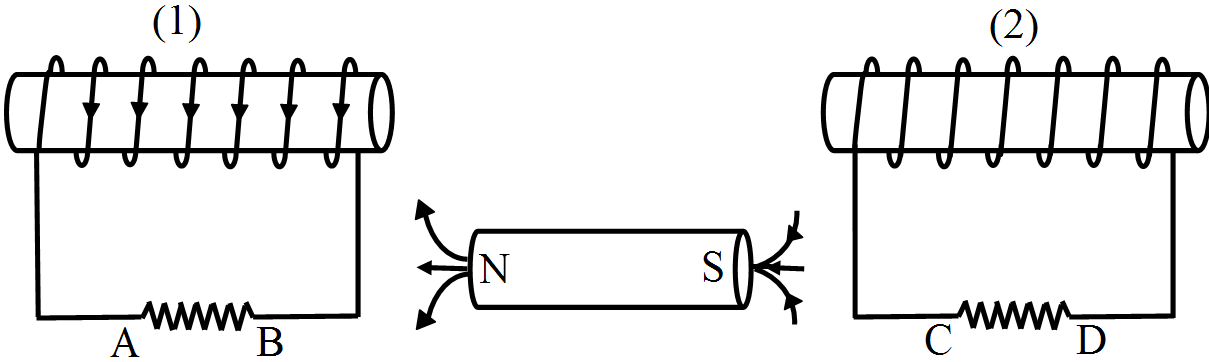
In the figure given below, a bar magnet moving towards the right or left induces an emf in the coils (1) and (2). Find, giving reason, the directions of the induced currents through the resistors AB and CD when the magnet is moving (a) towards the right, and (b) towards the left.
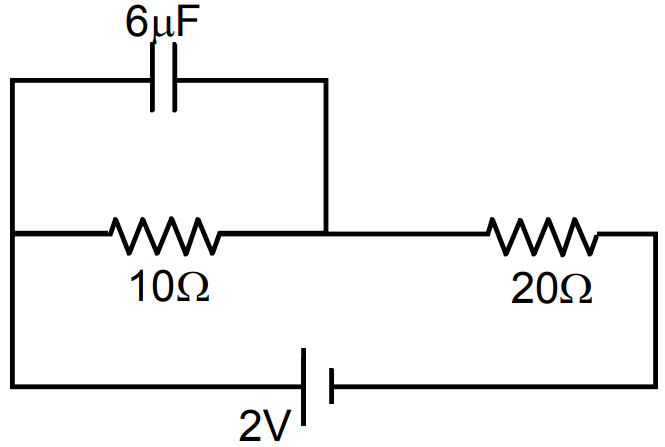
Find the charge on the capacitor shown in figure.
A tunnel is dug along a chord of the earth at a perpendicular distance $\frac{\text{R}}{2}$ from the earth's centre. The wall of the tunnel may be assumed to be frictionless. Find the force exerted by the wall on a particle of mass m when it is at a distance x from the centre of the tunnel.
The heat current is written as $\frac{\triangle\text{Q}}{\triangle\text{t}}.$ Why don't we write $\frac{\text{dQ}}{\text{dt}}?$
Figure, shows a string stretched by a block going over a pulley. The string vibrates in its tenth harmonic in unison with a particular tuning fork. When a beaker containing water is brought under the block so that the block is completely dipped into the beaker, the string vibrates in its eleventh harmonic. Find the density of the material of the block.
A rod is inserted as the core in the current-carrying solenoid of the previous problem.
  1. What is the magnetic intensity H at the centre?
  2. If the magnetization I of the core is found to be 0.12Nm, find the susceptibility of the material of the rod.
  3. Is the material paramagnetic, diamagnetic or ferromagnetic?
According to the station clocks, two babies are born at the same instant, one in Howrah and other in Delhi.
  1. Who is elder in the frame of 2301 Up Rajdhani Express going from Howrah to Delhi?
  2. Who is elder in the frame of 2302 Dn Rajdhani Express going from Delhi to Howrah.
A rod of mass m and length L, lying horizontally, is free to rotate about a vertical axis through its centre. A horizontal force of constant magnitude F acts on the rod at a distance of $\frac{\text{L}}{4}$ from the centre. The force is always perpendicular to the rod. Find the angle rotated by the rod during the time (t) after the motion starts.
 A proton and an $\alpha$ particle move perpendicular to a magnetic field. Find the ratio of radii of circular paths described by them when both have (i) equal velocities, and (ii) equal kinetic energy.
A point object is placed on the principal axis of a convex lens (f = 15cm) at a distance of 30cm from it. A glass plate $(\mu=1.50)$ of thickness 1cm is placed on the other side of the lens perpendicular to the axis. Locate the image of the point object.