Question
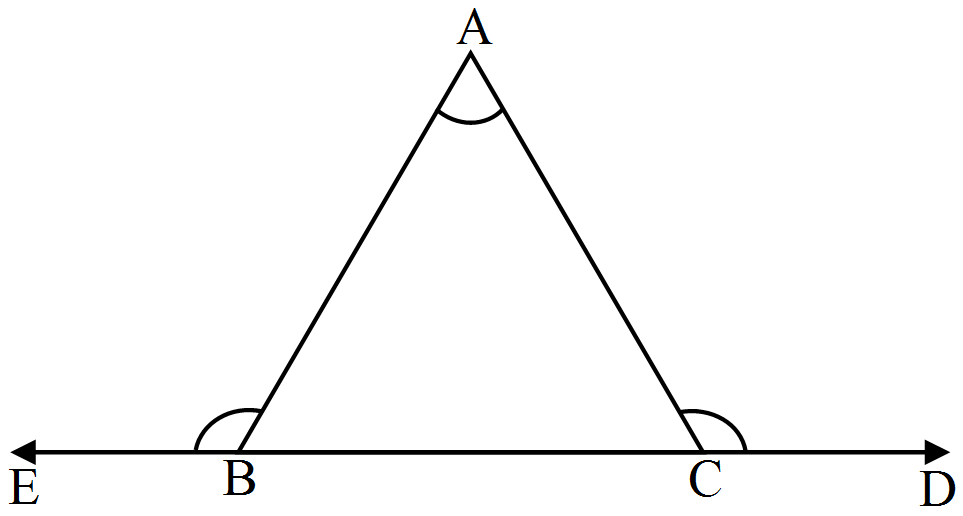
If the side $BC$ of $\triangle\text{ABC}$ is produced on both sides, then write the difference between the sum of the exterior angles so formed and $\angle\text{A}.$
Answer

In the given problem, we need to find the difference between the sum of the exterior angles and $\angle\text{A}.$
Now, according to the exterior angle theorem $\text{ext}.\angle\text{C}=\angle\text{A}+\angle\text{B}\dots(1)$
Also, $\text{ext}.\angle\text{B}=\angle\text{A}+\angle\text{C}\dots(2)$
Further, adding $(1)$ and $(2)$ $\text{ext}.\angle\text{C}+\text{ext}.\angle\text{B}=\angle\text{A}+\angle\text{B}+\angle\text{A}+\angle\text{C}$
$=2\angle\text{A}+\angle\text{B}+\angle\text{C}\dots(3)$
Also, according to the angle sum property of the triangle,
​​​​​​​we get, $\angle\text{A}+\angle\text{B}+\angle\text{C}=180^\circ\dots(4)$
Now, we need to find the difference between the sum of the exterior angles and $\angle\text{A}.$ Thus, $(\text{ext}.\angle\text{C}+\text{ext}.\angle\text{B})-\angle\text{A}=(2\angle\text{A}+\angle\text{B}+\angle\text{C})-\angle\text{A}$
$=\angle\text{A}+\angle\text{B}+\angle\text{C}$
$=180^\circ(\text{Using 4})$ Therefore, $(\text{ext}.\angle\text{C}+\text{ext}.\angle\text{B})-\angle\text{A}=180^\circ$

Need a full question paper?

Generate a complete, print-ready paper with questions like this in minutes — across 16+ boards, with answer keys.
Start Generating Free

Similar questions

If $\text{x}=\frac{\sqrt3+1}{2},$ find the value of $4\text{x}^3+2\text{x}^2-8\text{x}+7.$
Construct a frequency table with equal class intervals from the following data on the monthly wages (in rupees) of 28 laborers working in a factory, taking one of the class intervals as $210-230 (230$ not included$)$.$ 220, 268, 258, 242, 210, 268, 272, 242, 311, 290, 300, 320, 319, 304, 302, 218, 306, 292, 254, 278, 210, 240, 280, 316, 306, 215, 256, 236$.
If $x + y + z = 8$ and $xy + yz + zx = 20$, find value of $x^3 + y^3 + z^3 - 3xyz.$
$ABC$ is a right triangle such that $AB = AC$ and bisector of angle $C$ intersects the side $AB$ at $D.$ Prove that $AC + AD = BC.$
Construct a $\triangle \text{XYZ}$ in which $\angle\text{Y}=30^\circ,$ $\angle\text{Z}=90^\circ$ and $XY + YZ + ZX = 11\ cm$.
Each edge of a cube is increased by $50\%$. Find the percentage increase in the surface area of the cube.
E is the mid-point of the side AD of the trapezium ABCD with AB || DC. A line through E drawn parallel to AB intersect BC at F. Show that F is the mid-point of BC.
[Hint: Join AC]
ABCD is a parallelogram. A circle through A, B is so drawn that it intersects AD at P and BC at Q. Prove that P, Q, C and D are concyclic.
The sides of a quadrilateral $ABCD$ are $6\ cm, 8\ cm, 12\ cm$ and $14\ cm$ (taken in order) respectively, and the angle between the first two sides is a right angle. Find its area.