MCQ
If the solubility product of lead iodide $(Pb{l_2})$ is $3.2 \times {10^{ - 8}},$ then its solubility in moles/litre will be
  • $2 \times {10^{ - 3}}$
  • B
    $4 \times {10^{ - 4}}$
  • C
    $1.6 \times {10^{ - 5}}$
  • D
    $1.8 \times {10^{ - 5}}$

Answer

Correct option: A.
$2 \times {10^{ - 3}}$
(a) ${K_{sp}} = 4{S^3}$

$4{S^3} = 3.2 \times {10^{ - 8}}$ ; $S = 2 \times {10^{ - 3}}M$.

Need a full question paper?

Generate a complete, print-ready paper with questions like this in minutes — across 16+ boards, with answer keys.

Start Generating Free

Similar questions

Based on Hess's law calculations, what is the average $S-O$ bond energy in $SO_3$ if $\Delta H_f^o$ of $SO_3$ is $-270\, kJ\,mol^{-1}$. Bond energy of $O=O$ is $130\, kJ\,mol^{-1}$ and heat of sublimation for $S(s)$ is $100\, kJ\, mol^{-1}$ ? ....$ kJ\,mol^{-1}$
The enthalpy change of a chemical reaction $\Delta_r H$ equals ( $a_i$ and $b_i$ are stoichiometric coefficients)?
For a given chemical $A \rightarrow B$ at $300\, \mathrm{~K}$ the free energy change is $-49.4\, \mathrm{~kJ} \,\mathrm{~mol}^{-1}$ and the enthalpy of reaction is $51.4\, \mathrm{~kJ} \,\mathrm{~mol}^{-1}$. The entropy change of the reaction is $.....\,\mathrm{J}\, \mathrm{K}^{-1}\, \mathrm{~mol}^{-1} .$
The conjugate base of ${H_2}PO_4^ - $ is
If the heat of formation of $C{O_2}$ is$ - 393\,kJ$. The amount of heat evolved in the formation of $0.156 \,kg $ of $C{O_2}$ is.....$kJ$
${H_2}{O_{\left( g \right)}} + {C_{\left( s \right)}} \to C{O_{\left( g \right)}} + {H_2}\left( g \right)\,;\,\Delta H = 100\,kJ$

$C{O_{\left( g \right)}} + \frac{1}{2}{O_{2\left( g \right)}} \to C{O_{2\left( g \right)}}\,;\,\Delta H =  - 300\,kJ$

${H_2}_{\left( g \right)} + \frac{1}{2}{O_2}_{\left( g \right)} \to {H_2}{O_{\left( g \right)}}\,;\,\Delta H =  - 250\,kJ$

$C_{(s)} + O_{2(g)} \to  CO_{2(g)} ; \Delta H = -x\, kJ$

The value of $x$ will be
The molar solublity of $\mathrm{CaF}_{2} \left(\mathrm{K}_{\mathrm{sp}}=5.3 \times 10^{-11}\right)$ in $0.1 \mathrm{M}$ solution of NaF will be
Which of the following arrangement of molecules is correct on the basis of their dipole moments
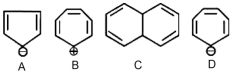
Which of the following structures are aromatic in nature?
In which of the following reactions is there a change in the oxidation number of nitrogen atom ?