MCQ
If the solution boils at a temperature ${T_1}$ and the solvent at a temperature ${T_2}$ the elevation of boiling point is given by
- A${T_1} + {T_2}$
- ✓${T_1} - {T_2}$
- C${T_2} - {T_1}$
- D${T_1} \div {T_2}$
The reason is after adding non-volatile solute the boiling point of the solution will increase.
Vapour pressure of the solution at some temperature is found to be lower than the vapour pressure of the pure solvent at the same temperature. In such a solution, the nonvolatile solute particles will obstruct the escaping of solvent molecules from the surface.
Therefore, it reduces the vapour pressure. Due to this, Elevation in the boiling point is based on the colligative property.
Generate a complete, print-ready paper with questions like this in minutes — across 16+ boards, with answer keys.
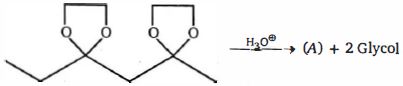
Major Product will be :-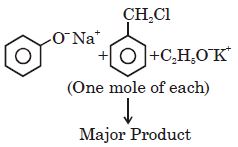
$I_2 + 2e^-\to 2I^-$ ; $E^o = 0.54 \,V$
$MnO_4^-+ 8H^+ + 5e^-\to Mn^{2+} + 4H_2O$ ; $E^o = 1.52\, V$
$Fe^{3+} + e^-\to Fe^{2+}$ ; $E^o = 0.77\, V$
$Sn^{4+} + 2e^-\to Sn^{2+}$ ; $E^o = 0.1\, V$
The strongest reducant and oxidant respectively are :